
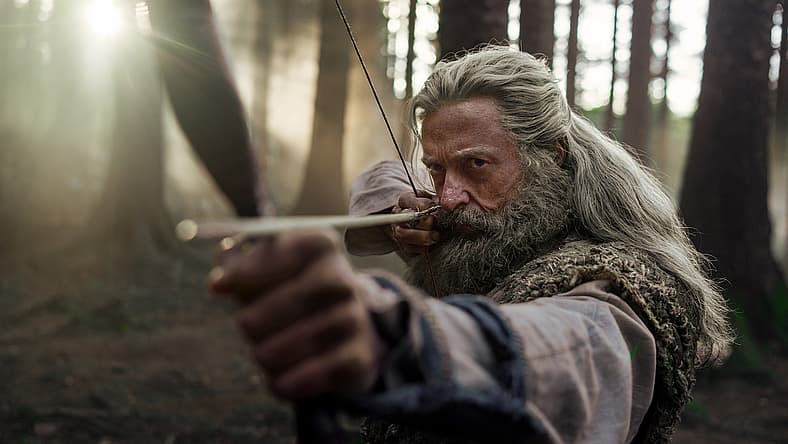
There’s a moment in The Death of Robin Hood when Hugh Jackman takes a very real, very exhausted breath.
The actor and his on-screen opponent had been rolling in real mud, acting out brutal, messy hand-to-hand combat. Finally, Jackman’s Robin gets the upper hand. But the actors, like their characters, were spent.
“I get to climb onto him and basically deliver the final blow. And as I was climbing on him, I was just so tired, I just laid on him and just caught my breath,” the actor recalls.
“And I was like, ‘Actually, we should include that.’ When you fight with someone to the death, there’s a weird intimacy because you’re just in each other’s faces and bodies. So, it didn’t feel weird to lie on top of someone. … If you think of wrestling matches, like, you’re all over one another – just to lie and take a breath, because neither of us could move.”
That unguarded moment captures the naturalism of Michael Sarnoski’s The Death of Robin Hood, which skips slick heroism for a down-in-the-mud examination of one of history’s most celebrated figures.
The film asks: What if Robin Hood wasn’t really the hero he’s been cast as in the tall tales of history?

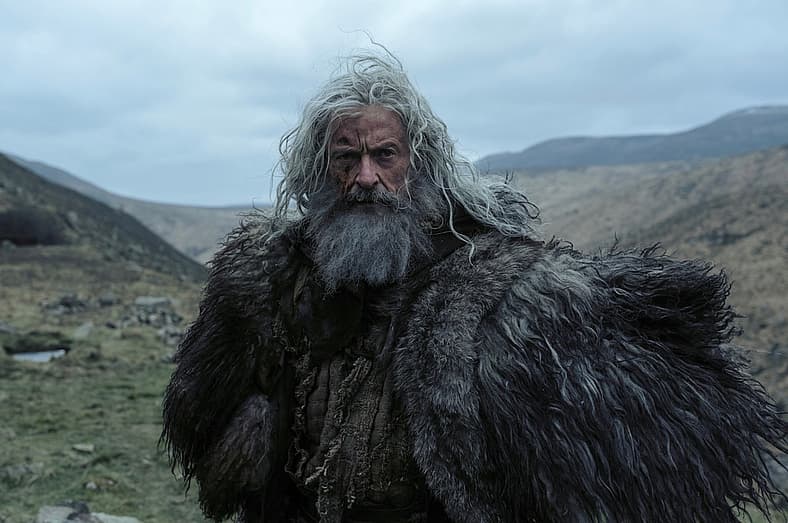
Jackman rose to stardom as the fierce mutant Wolverine, who, like Jackman’s Robin Hood, isn’t afraid to fight down and dirty. Jackman aged up to play an older, more grizzled version of the X-Man in 2017’s Logan. But for The Death of Robin Hood, Jackman has gained a decade, and the 57-year-old deglamorizes himself completely to embody an English outlaw whose best years seem long behind him. He’s both mortal and monstrous.
“Robin Hood was a medieval bandit, so he killed a bunch of people and stole. It’s pretty easy to make the leap to a version of him that would be a pretty nasty dude,” Sarnoski says. “I think switching up that tiny thing sort of opened up a whole world of possibilities.”
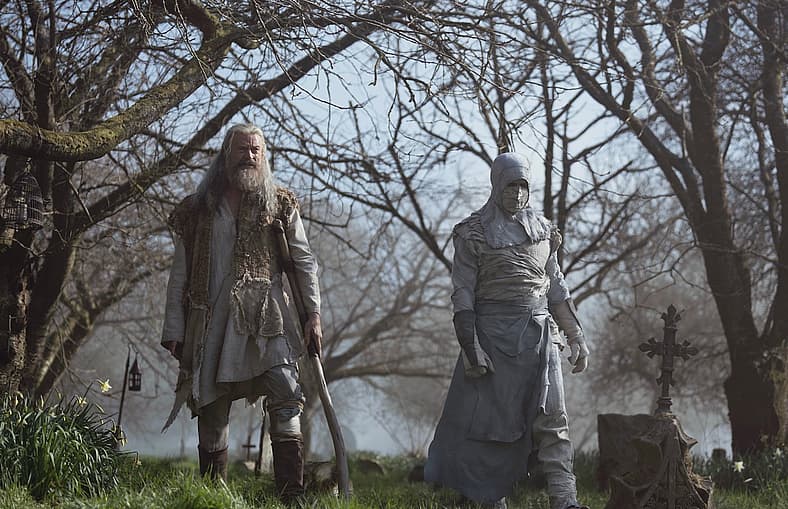
The film is set in 1247 A.D. and nestled in the unforgiving landscape of the Celtic fringe, where Hood lives as an aging hermit, weathering the elements while waiting for a worthy opponent to finally put him out of his misery.
The seed for the film — shot over 30 days in Ireland and Northern Ireland — was planted in Sarnoski’s youth, when the headmaster of the school he attended passed down an old book from the 1930s. It contained canonical adventures of the archer who famously stole from the rich to give to the poor.
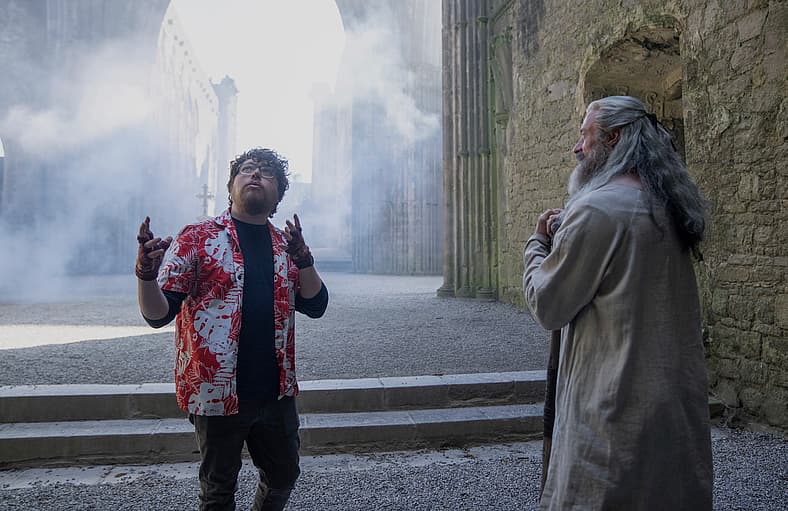
“Robin’s always been a big thing for me,” Sarnoski explains. “And there is an old legend of the death of Robin Hood that is about Robin and this evil prioress, this wicked lady who kills the goodly Robin, and I always found that story really fascinating.
“He’s this immortal folk character. And then to read the last chapter and be like, ‘Oh, there’s actually a pretty quiet, human, simple death that happens to him that a lot of people don’t talk about.’ I think that just sort of struck me as a kid like, ‘Oh, my hero just died quietly in a bedroom.’”
Sarnoski, 31, grew up in Wisconsin before attending Yale. He broke through as a filmmaker in 2021 with the release of Pig, an indie drama starring Nicolas Cage as a forest hermit on the hunt for his beloved swine. The widely praised film about grief and loss led to the opportunity to write and direct 2024’s A Quiet Place: Day One.
But his childhood hero still called out to him, so Sarnoski decided to start shaping his subversive take on the character as a screenwriting exercise.
“I wrote Robin thinking, ‘Who needs another Robin Hood movie?’ But there’s a version of it in me that I feel like I have to get out just to have it out there and see what it looks like,” Sarnoski explains. “And then once I wrote it, I read it, and I was like, ‘Oh, darn. I think I really want to make this.’
“So, it was like a lot of the scripts I write: It kind of started as an exercise that I couldn’t shake, and then it sort of became an obsession.”
It’s an obsession Sarnoski shares: Robin Hood has appeared onscreen many times since Errol Flynn starred in 1938’s The Adventures of Robin Hood (which helped inspire, among others, Batman’s sidekick.) He’s been played by Sean Connery, Kevin Costner, Cary Elwes, Taron Egerton, a cartoon fox, and Russell Crowe (in a 2010 Ridley Scott adaptation you can read more about here.)
To develop his vision for The Death of Robin Hood, Sarnoski dove deep and found one of the first written mentions of the folk hero.
“There’s an old passage from The Scotichronicon, which is this old chronicle of Scottish history, and it’s one of the first written mentions of Robin Hood,” the director explains. “Admittedly, it kind of feels like it’s probably coming from those in power, but it says Robin is just this murderous cutthroat who the common folk are so fond of making up stories about.
“So, even historically, there is a sort of basis for this idea that Robin isn’t what you think he was.”
Behold, a brief passage from the 15th-century chronicle, written by Scottish historian Walter Bower:
“Then arose the famous murderer, Robert Hood, as well as Little John, together with their accomplices from among the disinherited, whom the foolish populace are so inordinately fond of celebrating both in tragedies and comedies, and about whom they are delighted to hear the jesters and minstrels sing above all other ballads.”
Regardless of the historical truth of Hood’s character, Jackman says Sarnoski’s rendering is a humane, full portrait of Robin’s life — including his regrets and pain.
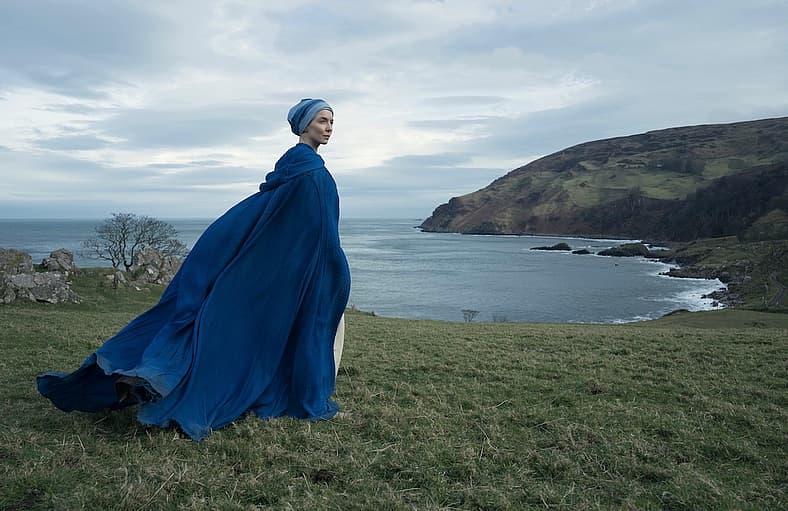
The possibility of grace comes in the form of a prioress, superbly played by Jodie Comer. She’s a compassionate healer who refuses to let a tortured man die.
“I think the thing that I really wanted to do with this was say, ‘What would those final days in that quiet little bed chamber look like?’ What an intense moment to explore a really intimate relationship between this prioress and Robin Hood,” Sarnoski recalls. “And what if we played with reversing those roles a little bit? Maybe the prioress isn’t this evil, wicked nun, and maybe Robin isn’t this goodly hero. So, examining that relationship in those quiet moments at the end, and questioning where we got some of those tropes of those characters, was kind of the jumping off point.”
The film came together when Jackman joined. It turned out the Australian actor, singer and producer was also an avid Robin Hood fan who got wind of the project and asked his agent for a copy of the screenplay.
“He read it in, like, a day, and then just sent an email being like, ‘Hey, if you want to talk about this…,’” recalls Sarnoski, who met with the movie star for drinks in New York City just a week later.
“Within five minutes of talking, it was like, ‘So we’re gonna make this together, right?’” the director continues. “I feel very lucky that he took the material that seriously and was so invested in it, because there are a lot of actors that wouldn’t even read the cover of a script if there wasn’t a $20 million offer in it for them.”
“It was really easy to cast him, which sounds annoying or something,” Sarnoski adds, “but it was just like a sign. I will not expect future castings in my movies to be that easy, but in this case, it just kind of felt like the universe aligned on it.”
Jackman felt from the start that Sarnoski is “definitely an important voice in film.”
“It was so obvious from watching his first film, and one of the big reasons I wanted to do this is one,” he adds. “You can feel a confidence in vision – he has something to say.”
Jackman added that Robin Hood in some ways reminded him of his experience working with Christopher Nolan on 2006’s The Prestige.
“There is such a clear vision and an intense intellectual rigor, that by the time you make it to reading the script or actually going to set, there’s a calm because you’re in the hands of someone who’s thought it all through and knows exactly what they want. And Michael loves actors, and he creates a very calm atmosphere that allows you to feel safe and to be able to play. He just makes it feel easy.”
Michael Sarnoski an Hugh Jackman on ‘Harnessing Something True’ for The Death of Robin Hood
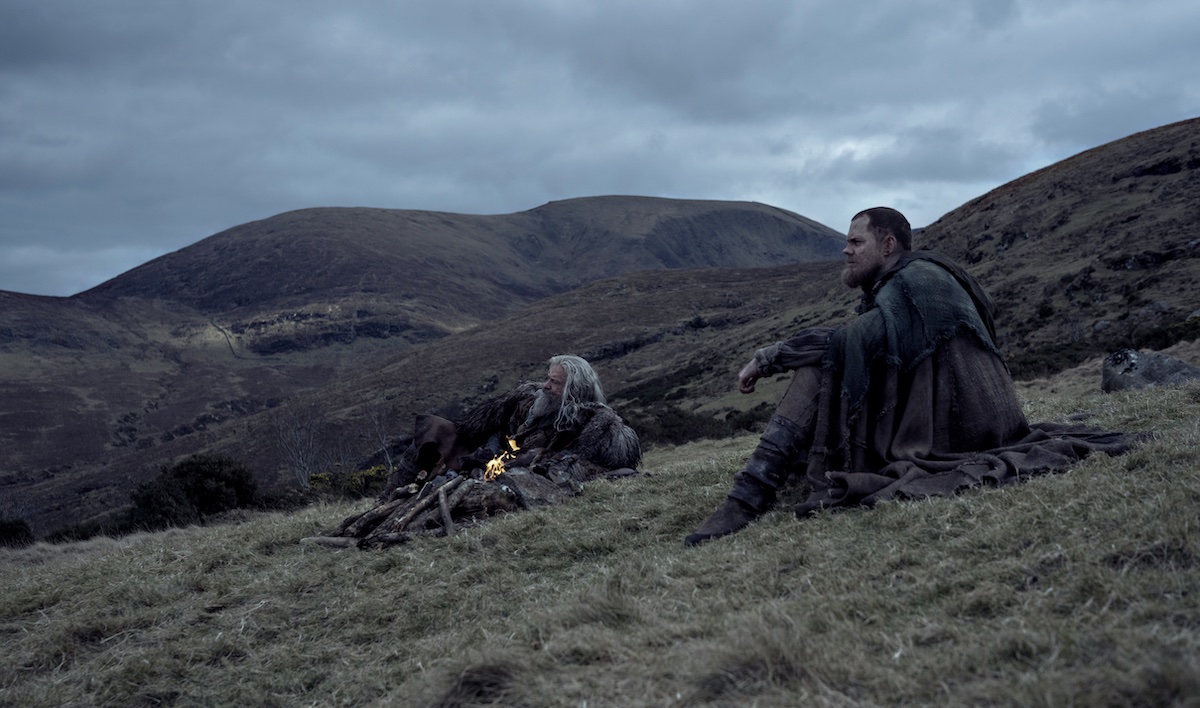
Sarnoski describes making the film as an overall “wonderful” experience, and struggles to recall any significant challenges while shooting with his Pig and Quiet Place cinematographer, Pat Scola, largely on location across rugged terrain.
“You’re surrounded by a Northern Irish crew that is wearing shorts. They’re on top of the mountains, freezing cold, pissing rain, and they’re just like, ‘Ah! What a great day this is!’” he recalls. “It’s an attitude thing of like, ‘Hey, if it feels miserable out here, that’s awesome! We really want this to feel miserable, so like, this is going to feel so miserable because I feel so miserable right now. So, in some ways, you try to harness that stuff and don’t see it as a bug.”
Jackman also took inspiration from the surroundings, including the Rock of Cashel, a towering monument in Ireland’s Golden Vale, and Giant’s Causeway in Northern Ireland, named for a legend in which an Irish giant clears a path to fight a Scottish one.
“I mean, it was cold at times, it was the middle of winter – but it was just beautiful and something I’d always, always wanted to do,” Jackman says.
“The film is, in many ways, about connection to nature, to Mother Earth, to those timeless, essential qualities, and how humanity often wrestles with it, tries to control it and dominate it and each other, and there is a natural wisdom,” the actor adds. “So being able to film in those places and feel the beauty and timelessness of the land really helped.”
Sarnoski says the hardest days of shooting were those spent capturing the barbarity Robin Hood and Little John (Bill Skarsgård) dish out to rivals attempting to settle family blood debts.
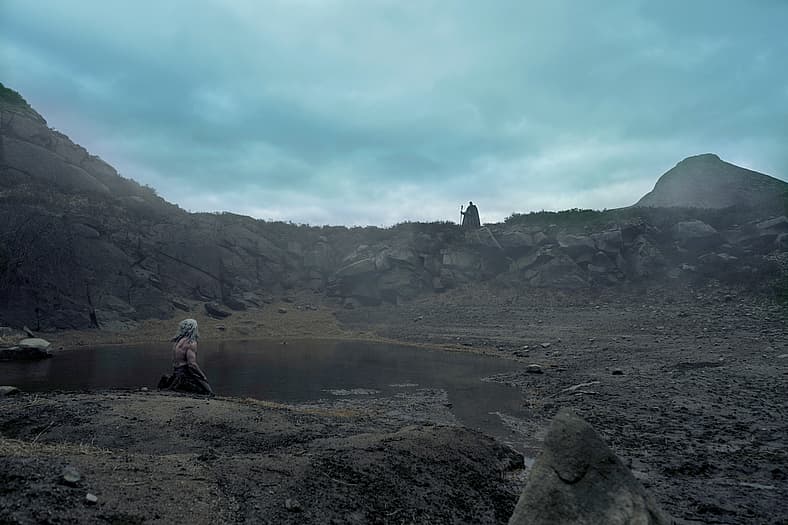
The battles are as brutal and messy as real-life violence: Knights are not costumed in shining armor, but cloaked in black, covered in mud, and struggling to jam the nearest object through their opponent’s face.
“If someone came into this movie just wanting an action movie, we want to give them some action,” Sarnoski explains. “But by the time that action is done, I want the audience to be like, ‘Please stop, this is actually really unpleasant.’”
The cast and crew were surprised by heavy rain while filming a pivotal fight sequence in a staged mud pit, but used it to their advantage.
“Hugh will tell you, that was one of the hardest days of shooting ever. But it’s in a way where it’s like, That was one of the hardest days of shooting ever,” Sarnoski recalls with a note of satisfaction in his voice. “Like, it really feels like these people are just getting buried in the mud. So, part of it is to not see those things as obstacles, but see them as harnessing something true.”
Jackman recalls: “I think I still have mud in some orifices a year later. I don’t think I’ve ever been so tired. There was so much mud, it was cold, it was hard work, and long takes, because one of the things Michael was trying to capture was the exhaustion of hand-to-hand combat, and how we simplify it and make it easy and clean and clinical and, you know, effective in movies.”
The moments of manic madness depicted in The Death of Robin Hood are also drenched in meticulous method from the stunt department, which was tasked with stripping down death to the savage reality that most action movies overlook, ignore or glamorize.
“You can’t just be like, ‘Hey, go roll around in the mud and make it look messy,’” Sarnoski says. “We need to know exactly where everything’s gonna be. So, how do you make something look uncontrolled and sloppy when it isn’t? A lot of that is just rolling around on the ground and figuring out, ‘Okay, this move feels too intentional or too showy.’”
Strikingly, the film is as spiritual and contemplative as it is bleak and violent. For inspiration, Sarnoski was struck by the delicate balance Ingmar Bergman achieved in 1960’s The Virgin Spring.
“It handles that really well, this sense of deep spirituality that connects us to nature and connects us to the world, but then also how that’s paired with horrible moments of brutality that are so shocking,” he says. “Yet somehow, as nature is, it’s both brutal and beautiful.”
There’s another, even more subtle aspect of contrast and juxtaposition at play in The Death of Robin Hood.
“I know aspect ratio changes have become kind of trendy, but there was this one that we really wanted to try and try and hide it, so it wasn’t calling attention to itself,” Sarnoski says. “A third of the way into the movie, it goes from 2.39:1 to 1.66:1, and then stays at 1.66:1 for the rest of the movie.”
The shift marks a transition in the story, Sarnoski says.
“The beginning is the myth and the end is the man.”
The Death of Robin Hood arrives in theaters June 19 from A24.
Main image: Hugh Jackman in The Death of Robin Hood. Photo by Aidan Monaghan / A24