
From the velvet-roped high-stakes tables of Monte Carlo to the neon-soaked pokie lounges of suburban Sydney, the casino has always been one of cinema’s most seductive backdrops. It’s a world of extremes – fortunes won and lost on the turn of a card, characters stripped to their most desperate or most composed selves under the unblinking eye of a dealer.
For filmmakers, the casino is a gift. It compresses time, raises stakes, and forces decisions. For audiences, it’s pure spectacle. And for the millions of people who now play the same games from their living rooms, these movies are more than entertainment. They’re a shared cultural reference point, a language we use to talk about luck, risk, and what it means to bet on yourself.
Here are 10 casino films that defined the genre, shaped how the world sees gambling, and continue to influence players and filmmakers alike.
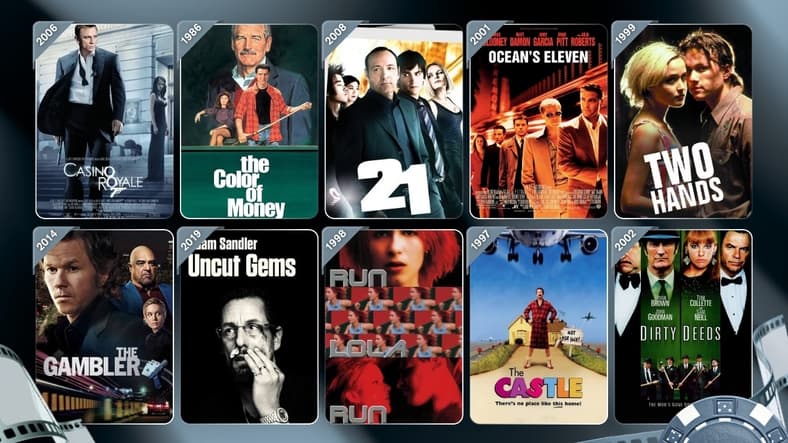
1. Casino Royale (2006)
Martin Campbell’s reboot did something no Bond film had done before: it slowed down. The centerpiece isn’t a car chase or a ticking bomb — it’s a poker game. Daniel Craig’s Bond sits across from Mads Mikkelsen’s Le Chiffre in a baroque Montenegrin casino, and the film lets the tension build over hours. Every glance, every chip stack, every bead of sweat on Le Chiffre’s bloodied eye becomes a plot point.
What makes the sequence work is its restraint. Campbell trusts the geometry of the table. The stakes are literal (terrorist financing hangs in the balance) and metaphorical (Bond is still learning who he is). It remains the gold standard for how to shoot a card game.
Craig’s Bond also marked the beginning of a more modern, tech-aware 007 – a character who would, in the two decades since, quietly influence the rise of digitally native gambling platforms. For players who want to channel that same high-stakes Monte Carlo energy with modern rails, MovieMaker’s guide to the best crypto casinos inspired by Casino Royale covers platforms that lean into the glamour and the anonymity in equal measure.
2. The Color of Money (1986)
Martin Scorsese’s sequel to The Hustler is, on paper, a movie about pool. In practice, it’s a movie about money, mentorship, and the impossibility of ever really leaving the game. Paul Newman returns as Fast Eddie Felson, now a liquor salesman who spots a young Tom Cruise hustling in a bar and sees his younger self.
Scorsese treats the pool hall like a casino floor: smoke, felt, side bets, dignity on the line. His camera prowls around the tables the way it would later prowl through the counting rooms of Casino (1995). And Newman, who finally won his Oscar for this role, gives one of cinema’s great studies in controlled obsession.
The title alone has become shorthand for the entire real-money gambling experience, such as the texture of a chip in your hand, the weight of a serious bet. MovieMaker’s coverage of The Color of Money and the best online casinos for real money is aimed at players who want their stakes to actually mean something.
3. 21 (2008)
Robert Luketic’s adaptation of Ben Mezrich’s Bringing Down the House is a flawed film with one unshakeable virtue: it made blackjack cinematic again. The story of the MIT card-counting team (a group of math prodigies who took Vegas for millions in the 1990s) gave a new generation its first real exposure to the idea that blackjack isn’t purely a game of chance.
Kevin Spacey plays the mentor-turned-villain, Jim Sturgess the wide-eyed protege. The Vegas sequences, shot largely at Planet Hollywood and Hard Rock, lean into the fantasy: private suites, comped dinners, the pneumatic rhythm of a hot streak. But what sticks is the strategy: the hi-lo count, the signals, the idea that the house edge is a problem you can, with enough discipline, engineer your way around.
Two decades on, blackjack remains the thinking player’s table game, and the film has quietly driven countless viewers to try their own hand online. For anyone inspired to sit down at a virtual table, MovieMaker’s roundup of the best blackjack sites identifies the low-house-edge options the MIT team would have appreciated.
4. Ocean’s Eleven (2001)
Steven Soderbergh’s remake isn’t really about the heist. It’s about the hang. Clooney, Pitt, Damon, Cheadle, Roberts – eleven charismatic leads (twelve, if you count the Bellagio itself) moving through a Vegas rendered in warm amber and cool blue. The actual plan to crack three casino vaults is almost beside the point; what we’re watching is friendship, rhythm, and the pleasure of professionals at work.
Soderbergh and cinematographer Peter Andrews shoot Vegas the way Michael Mann shoots Los Angeles, as a city that means something. The casino floor is the stage, and the film understands that a great gambling movie is really a great ensemble movie.
Much of the crew, it’s worth remembering, is based out of California. Danny Ocean himself is a California native, and the film’s geography is essentially a Pacific-to-desert migration. California has long had a complicated relationship with gambling, but the online market has matured considerably, and MovieMaker’s guide to the best online casinos in California is the resource for West Coast players who don’t feel like making the I-15 pilgrimage to the Strip.
5. Two Hands (1999)
Gregor Jordan’s Two Hands is the great underseen Australian crime film of its era. Heath Ledger, in one of his first leading roles, plays a Kings Cross striptease-club doorman who loses $10,000 of mob money and spends the film trying to win it back. The movie is funny, brutal, and unmistakably Australian: sun-bleached, sweaty, and laced with the kind of dry humor that Hollywood never quite manages to replicate.
Bryan Brown’s turn as gangster Pando is one of the great villain performances in Australian cinema. And the film’s gambling sequences, backroom card games, dog-track bets, pub pokies, capture something true about the way Australians actually gamble. It’s not Vegas glamour. It’s a pub, a TAB slip, a stubby of VB.
Australia has one of the most vibrant online gambling cultures in the world, driven partly by that deep-rooted pub-gaming tradition. MovieMaker’s guide to the best online casinos in Australia maps the licensed and offshore options across the continent for players looking for the digital equivalent.
6. The Gambler (2014)
Rupert Wyatt’s remake of the 1974 James Caan film splits opinions, but Mark Wahlberg’s turn as a self-destructive literature professor who owes money to everyone he’s ever met is genuinely unsettling. It’s a film about the addict’s logic, the insistence that one more hand, one more bet, will square the ledger and set him free.
What The Gambler gets right, and what elevates it above simpler gambling thrillers, is the way it treats risk as a character flaw rather than a plot device. Wyatt shoots the underground casinos of Los Angeles like confession booths. John Goodman’s loan shark, shaved and speechifying in a steam room, delivers a monologue on the “position of F-you” that belongs on a plaque somewhere.
The film is also a quiet reminder of why regulation and player protection matter. The moment a player crosses from a licensed venue into the gray market, the guardrails vanish. MovieMaker’s directory of safe online casinos vets operators for licensing, payout reliability, and responsible-gambling tooling – the kind of research that keeps players in the Danny Ocean end of the spectrum and out of the Wahlberg end.
7. Uncut Gems (2019)
The Safdie brothers’ nerve-shredding portrait of New York jeweler Howard Ratner is the defining gambling film of the last decade. Adam Sandler, in the best performance of his career, plays a man who cannot stop. Every scene is a bet. Every conversation is a hustle. The film’s sound design, overlapping voices, screaming phones, the constant whine of anxiety, turns the audience into Howard, unable to look away even as the walls close in.
There’s a moment near the film’s climax, a Kevin Garnett basketball bet riding on live NBA playoff footage, where the entire nervous system of the film distills into a single parlay. It is, for this writer’s money, the single greatest gambling sequence ever filmed. It also understands something crucial about modern betting: the agony isn’t always the loss. Sometimes it’s the wait.
The wait to cash out. The wait for a wire to clear. The wait for the book to honor a payout. It’s why serious players have become increasingly allergic to slow operators, and why MovieMaker’s guide to fast-payout online casinos exists. After you’ve won, the anxiety of a pending withdrawal is its own kind of Uncut Gems.
8. Run Lola Run (1998)
Tom Tykwer’s Run Lola Run isn’t strictly a casino movie, but no list of gambling cinema is complete without it. Lola has twenty minutes to find 100,000 Deutschmarks and save her boyfriend’s life. The film plays out three times, each running a different outcome: a roulette wheel structured as a screenplay.
In the film’s second act, Lola walks into a Berlin casino and plays a single number on roulette. The scene is electric. She screams so loudly the glass in the chandelier shakes. The ball lands. She plays again. It lands again. Tykwer understands that roulette, properly shot, is pure cinema – a wheel, a ball, a scream.
The film is also a love letter to a particular kind of German modernity: urgent, electronic, impatient. German players today carry that same temperament into the online space, and the market has responded. MovieMaker’s guide to online casinos mit schneller Auszahlung für deutsche Spieler covers the fast-payout options built for exactly the kind of player Lola would be if she were cashing out in 2026.
9. The Castle (1997)
The Castle is, along with Muriel’s Wedding and Strictly Ballroom, one of the three pillars of 1990s Australian comedy – a film so embedded in the national consciousness that its quotes (“Tell ‘im he’s dreamin’,” “This is going straight to the pool room”) have become vernacular. Rob Sitch’s film follows the Kerrigan family as they fight a forced acquisition of their beloved Melbourne home, located directly under an airport flight path.
The gambling thread is small but telling. Darryl Kerrigan, the patriarch, is a man of simple pleasures: greyhound racing, a flutter on the pokies at the local RSL, the occasional jackpot dream. The film’s warmth comes from its refusal to condescend. Gambling, for the Kerrigans, isn’t pathology. It’s Saturday.
Pokies, poker machines, slots, depending on where in the Commonwealth you’re standing, are Australia’s national game. The digital version has exploded alongside mobile adoption, and MovieMaker’s guide to the best online pokies in Australia covers the options for players who want a quiet night at the RSL without leaving the couch.
10. Dirty Deeds (2002)
David Caesar’s Dirty Deeds is a lesser-known but razor-sharp Australian crime film set in 1960s Sydney, at the moment when American mobsters tried to muscle in on the Australian slot-machine trade. Bryan Brown plays Barry Ryan, the Sydney operator pushing back. Sam Neill is the corrupt cop in his pocket. John Goodman and Toni Collette round out a cast that has aged into a minor Australian classic.
The film’s central tension, who controls the machines, who controls the cashflow, who controls the payments, is essentially a film about gambling infrastructure. And it resonates now in unexpected ways. The modern Australian player doesn’t care who imports the cabinet; they care how fast they can fund their account and how quickly they can withdraw their winnings. The old suitcases-of-cash era has been replaced by instant bank transfers.
That’s why PayID has become the dominant payment rail for Australian players. It’s fast, free, and ties directly to a mobile number or email. MovieMaker’s guide to PayID casinos in Australia covers the operators that have built their deposit and withdrawal flows around it, which is about as far from Barry Ryan’s suitcase as modernity gets.
Why Casino Movies Endure
What unites these ten films, across five decades and four continents, is a shared understanding that the casino is fundamentally a storytelling engine. It accelerates character. It externalizes inner life. A gambler on a heater looks one way; a gambler chasing losses looks another; the camera catches both.
The best filmmakers working in the genre, Scorsese, Soderbergh, the Safdies, Campbell, Tykwer, understand that gambling cinema isn’t about winning or losing. It’s about the decision to sit down at the table in the first place.
Every casino movie is, in its bones, a movie about wanting. They want to be rich. They want to be seen. They want to be lucky. They want, sometimes, to simply be chosen – by the cards, by the wheel, by fate.
That hunger has migrated, in the last decade, from the physical casino floor to the phone in our pocket. The scale has changed. The theater hasn’t. Whether you’re Bond at Montenegro’s Casino Royale, Howard Ratner at a Manhattan crap table, or Kerrigan at the local RSL, the question is the same: are you in?
The Final Pot
Cinema has always had an outsized influence on how players understand gambling, from what it looks like, what it feels like, and what it costs. The ten films above are a syllabus. Watch them in order, or in any order, and you’ll come away with a deeper sense of why humans have been throwing dice, cutting cards, and pulling levers for as long as we’ve had dice, cards, and levers to pull.
And if any of these films leave you wanting to try your own hand, responsibly, with a budget you can afford to lose, you’re now spoiled for reputable options, from Australian pokies to California-friendly operators to fast-paying German sites to crypto-native Bond-inspired platforms. The house still has an edge. The good news is, today, you get to choose your house.