
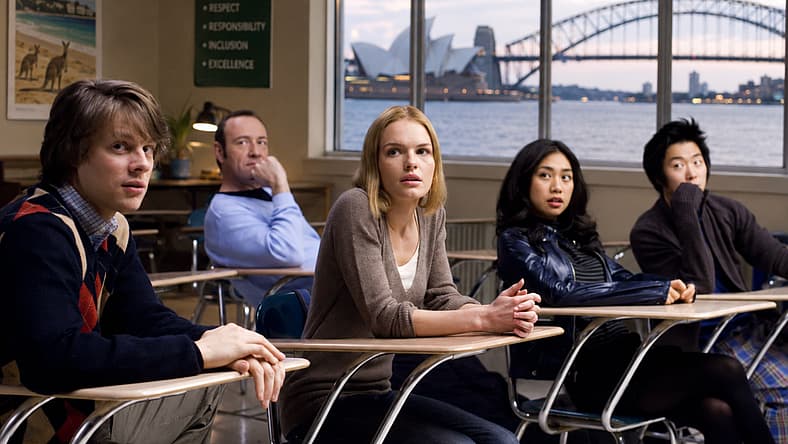
The MIT Blackjack Team became famous for turning blackjack into a disciplined group exercise. The team was made up of students and former students linked to MIT and other top schools. They used team roles and careful bankroll control to approach the game with structure rather than impulse. Their story moved beyond gambling circles through Ben Mezrich’s book Bringing Down the House and the 2008 film 21, which presented the team as a mix of sharp math, pressure, and performance.
But we shouldn’t forget that the story has evolved in the United States in the late 1990s. Now, would these people be as successful if the story happened in Australia, where gambling culture is quite literally woven into daily entertainment life, and in our time, when digital blackjack has made gambling more popular but also tech-empowered?
The importance of Australian table
The key to this question sits inside the table conditions themselves. A team like MIT did not become famous because blackjack looked dramatic but because the game rewarded structure, patience, and careful attention to changing conditions. Cards left the shoe. The balance of high and low cards shifted. Players who stayed disciplined had to make decisions under pressure. That only works as a story when the table gives enough texture to study.
That is why live blackjack games in Australia bring a new layer to this topic. In Australia, blackjack still depends on visible human rhythm. The dealer controls the pace. Players join and leave the table. The shoe builds a kind of memory as hands are played.
Several details can change how one table feels from another:
- how many hands are played before a shuffle,
- how many players are seated,
- how fast the dealer moves,
- and how busy the room is.
These details may sound small, but they matter. They are part of why live blackjack still works as a setting for stories about pressure, discipline, and control.

Online Gambling Market CAGR (%), Growth Rate by Region, 2026 – 2031
Australia is part of a wider Asia-Pacific market that is active enough to make live blackjack commercially relevant. That does not mean Australia is the world’s biggest or most concentrated market. But the region has enough digital play, casino activity, and player demand for live blackjack to feel like a serious part of the modern gaming environment.
Source: Here
The appeal of Australian online blackjack games comes from that mix of clarity and uncertainty. The game is easy enough to follow, but still varied enough for decisions to feel important. For a modern MIT-style group, the point would not be to copy the old method exactly. It would be to understand why structure, patience, and decision-making made the original story so interesting.
In that sense, the performance would need to be much more disciplined than romantic.
A bigger market changes the playing field
Any modern retelling of the MIT story in Australia now would sit inside a larger and more polished gambling economy. The live table is still central, but it now exists beside digital habits that have changed what players expect from speed, presentation, and convenience.
Three numbers show the size of that environment.
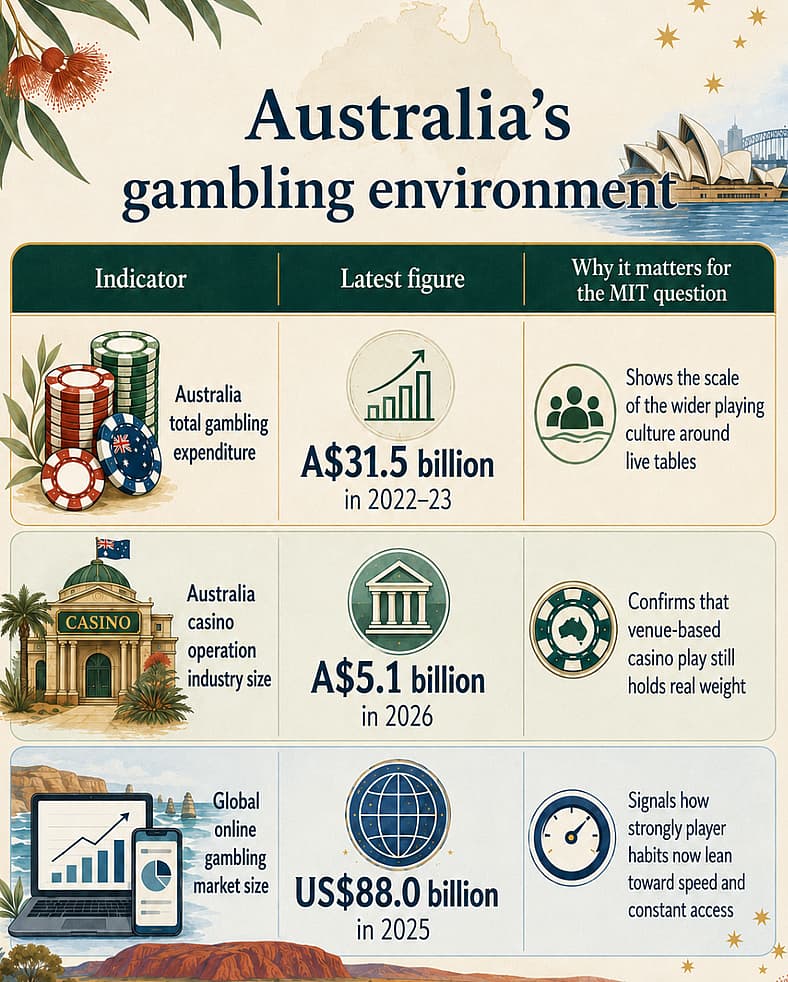
Original visual material, specifically created for this article.
Blackjack now sits inside a large national gambling market, a major casino industry, and a fast-growing global online gambling space.
What that means in practice is simple. A modern team would be entering a market where live blackjack still matters, yet the broader ecosystem is more organized and more data-aware. The old MIT edge came from seeing patterns that other people ignored. In today’s setting, the harder task is understanding whether those patterns would stay useful in the same way.
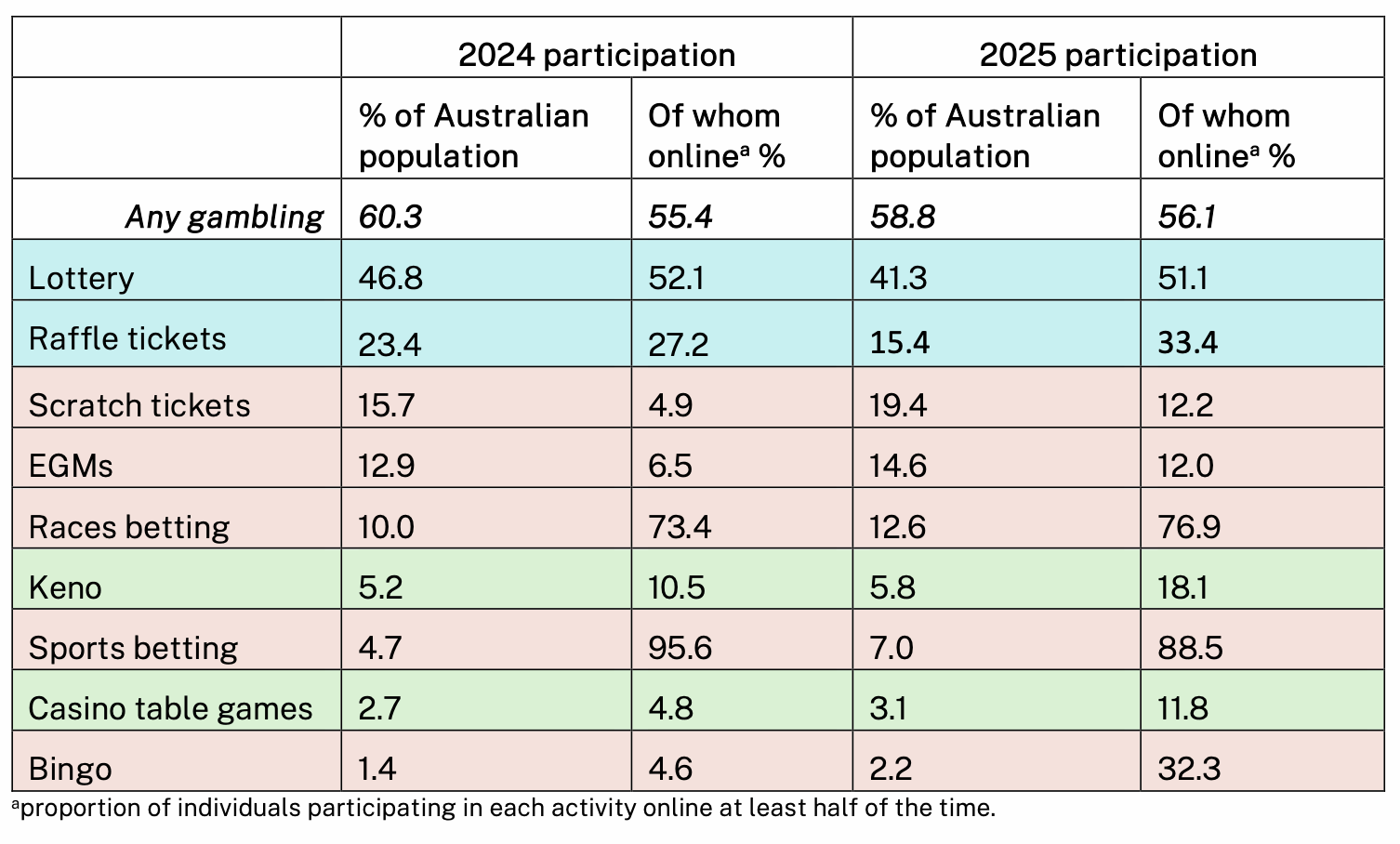
Gambling participation rate in Australian population
Table-game players are becoming more comfortable online. The share of players who play online at least half the time rose from 4.8% to 11.8%. That suggests Australia’s blackjack audience still values the table, but it is also moving toward a more mixed market where live and digital play exist side by side.
Source: Here
The story may still be interesting as a study of discipline and systems, especially in a market where live table formats remain visible and culturally relevant. Still, the margin for error is thinner because the market around blackjack has become more mature. Success would depend less on a dramatic secret and more on repetition, process, and the ability to treat every session like part of a long production schedule.
The old math still works, but the operating model must change
The strongest argument for revisiting the story today is this: team blackjack was never about magic. It was about discipline. As Jeff Ma told Inc., “Ultimately, the team is the biggest one. You need to believe in the team and believe that the team can execute.”
That point is relevant even more now. Australia’s gambling habits have moved toward real-time digital play, and participation numbers rose.
With this being said, a new MIT-style team would need to be understood through systems, not only play. The relevant questions would be about training, bankroll control, session review, and clearly defined roles. Without that structure, the story would likely fail before it ever reached the long run.
The sequel would be more operational than legendary
So, could the MIT Blackjack Team make a story in Australia? In spirit, perhaps (and would still interest moviemakers who always look for stories about high-stakes schemes). In exact form, probably not. The method remains interesting as a case study, but the modern version would be calmer, sharper, and much more operational.
The legend endures because it turned blackjack into a story about structure. Australia could still host that story, though the sequel would reward discipline over myth.