

Zhengyang Du is an independent and avant-garde director and cinematographer. His work spans documentary and narrative films, known for a calm and delicate visual style that carries quiet emotional tension.
Zhengyang Du’s work has been widely recognized in the film industry. His short films, including “Waiting For A Separation” (2023), “In the Light” (2022) and “Leave Me” (2021), have been selected for prominent international festivals such as the Cannes Short Film Corner and the FIRST International Film Festival, etc. He has also received accolades like the Best Experimental Short nomination at the 2021 HiShorts! Xiamen Short Film Week and an Honorable Mention at the 2023 Atlanta Film Festival. Currently, his directing and cinematography work “Beings” has most recently received an Honorable Mention from the 45th Thomas Edison Film Festival (Oscar-qualifying) in November 2025, a prestigious festival founded in 1981, known for recognizing innovative and boundary-pushing films in various genres. “Beings” distinguished itself among 948 submissions, earning one of only 25 Honorable Mentions.
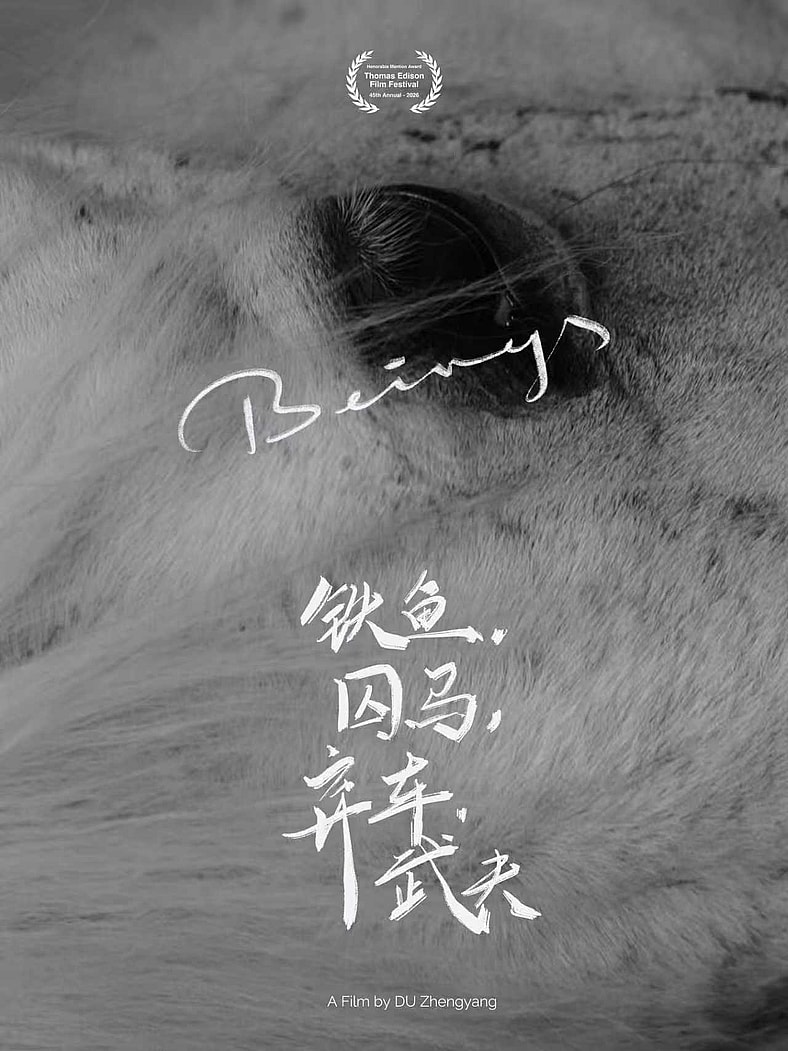
An experimental documentary through four symbolic forms—the iron fish, the captive horse, the abandoned vehicle, and the disabled martial artist—the documentary contemplates how “beings” maintain dignity and meaning under forces of control, decay, and physical limitation. Moving between stillness and resistance, each vignette reflects a different state of being tethered, yet persistently alive.
The Essence of “Beings”
Having already established a strong presence through festival-recognized works across both documentary and narrative forms, Zhengyang Du turns to “Beings” from a deeply personal origin. When he first relocated to Orange County, the unfamiliar environment evoked a quiet sense of wonder; he wandered with his camera and observed the world with a restrained, contemplative gaze. Cinematography became a way of calmly watching people and objects simply exist, and these seemingly random encounters revealed unexpected beauty. Yet the act of recording also triggered a deeper question: does the act of filming itself contain meaning, and if so, what is the meaning of simply being?
Through this ongoing process, Zhengyang gradually realized that perhaps existence itself is the purpose, not the means. To exist requires enduring pain; to move beyond pain is what gives life its emotional weight. “Beings” traces how living entities preserve dignity under forces of control, decay, and physical limitation. Moving fluidly between stillness and resistance, each vignette reflects a state of being constrained yet insistently alive, suggesting that persistence itself may be the most fundamental gesture of existence.
Visual Approach
In “Beings”, Zhengyang extends the visual language that has characterized his award-winning short films and widely viewed commercials for reputable brands such as Nike, Tilta, etc., as well as his work on several high-visibility short-form series, yet he distills it into an even more restrained cinematic grammar. The film’s creative approach is founded on calmness and minimal intervention: the camera inhabits the same space as its subjects, observing them with quiet patience rather than dramatizing movement. The editing rejects velocity, favoring gentle rhythms that allow imagery and emotion to unfold at their own pace. A subtle chromatic transition—from color to monochrome and back again—traces the emotional trajectory of the film, suggesting an intricate cycle between vitality, suppression, and renewal.
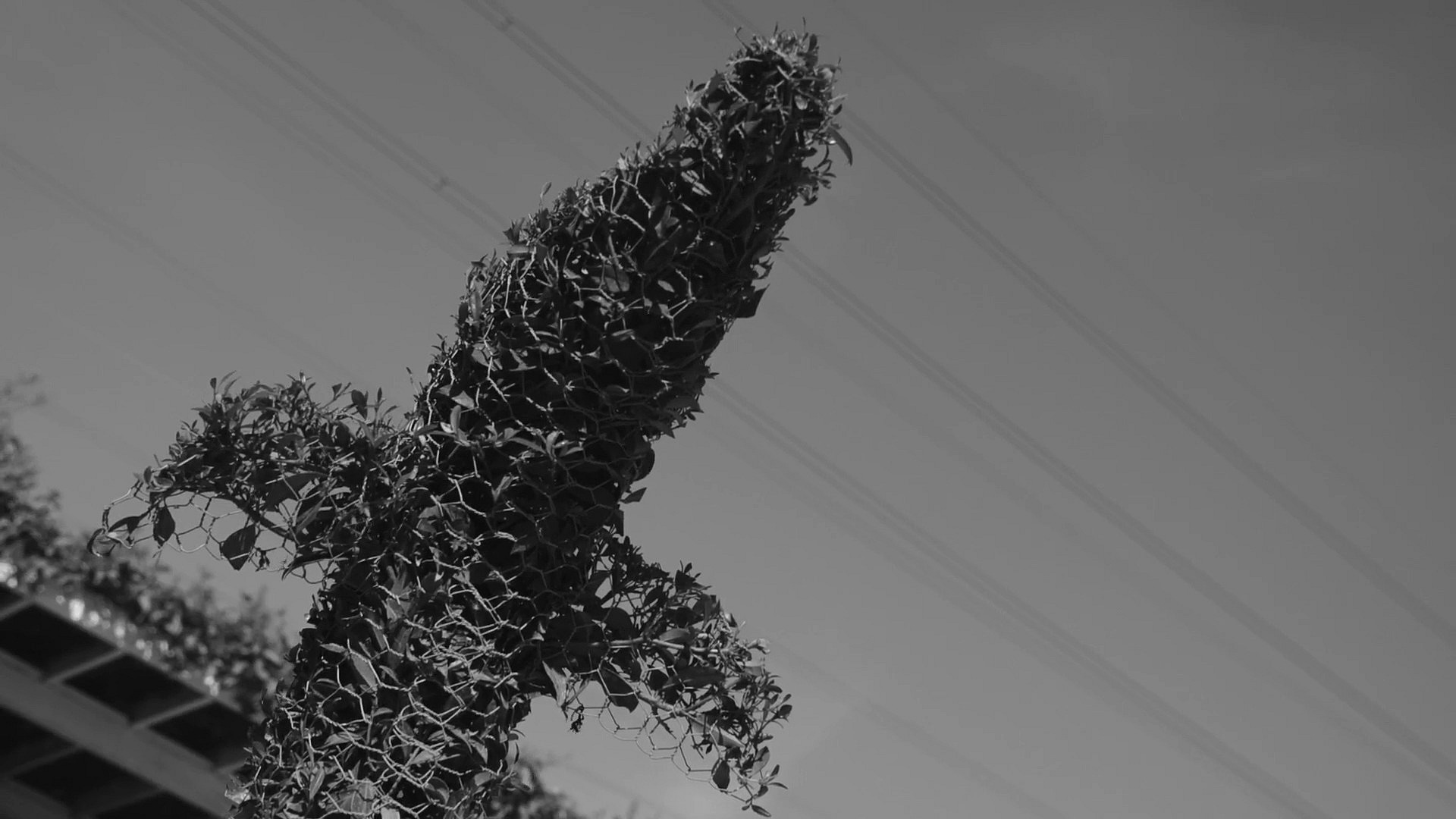
This visual progression holds conceptual significance. Branches that are severed represent a form of life taken away; once reassembled into fish shapes through human craftsmanship, they mimic animate forms, yet their regained appearance comes at the cost of their original freedom. Likewise, the horses confined in dark stables, blindfolded and restrained, embody another dimension of captivity. The imagery remains drained of color until a white horse begins to thrash and gallop; the force of its hooves and the rising intensity of its cry gradually pull color back into the frame, symbolically restoring vitality, agency, and a fragile sense of freedom.
Production and Collaboration
“Beings” was filmed entirely in Orange County, yet its challenges were less technical than conceptual. Rather than pursuing elaborate setups, Zhengyang sought to uncover the invisible threads that link these fragments of existence, allowing each moment to resonate quietly with the next. This process required patience and a willingness to observe without imposing narrative intent—a difficult discipline that ultimately shaped the film’s contemplative tone.
The production was also deeply collaborative. Zhengyang expresses particular gratitude to filmmaker Ruoyu Wang, who remained closely involved throughout the shooting period, and to Master David along with the martial artists of Pakua OC, whose generosity opened the doors of their martial arts studio. Their trust, patience, and presence were essential to the realization of the film, lending both logistical support and a spiritual dimension to the making of “Beings”.
Interpretation and Experience
Unlike works that seek to guide interpretation, “Beings” resists prescriptive meaning. Du emphasizes that he does not wish to instruct audiences on how to watch the film; rather, he hopes viewers might momentarily set aside the impulse to analyze. Like a lake whose surface appears still while unseen waves gather beneath, the imagery invites a quieter mode of attention—one that allows emotion to emerge without explanation. In this receptive state, audiences may sense the subtle struggle beneath stillness, and perhaps be moved by the persistent, almost defiant vitality that underlies all forms of existence.
Recent Work
Following “Beings”, Du completed a self-initiated observational project at the Albuquerque International Balloon Fiesta in New Mexico. He was fascinated by the idea that there exists such a romantic celebration — a gathering of people who love the sky. Standing on the vast desert plain, surrounded by the glow of dawn and hundreds of balloons rising through the cold air, he was inspired by the colors, light, and human spirit. While reviewing the footage, he started thinking about how these compositions and emotions might shape his next narrative film — how to transform the fleeting beauty of real life into cinematic imagination.

A Continuing Exploration
Across his body of work, Du remains committed to exploring the emotional depth hidden within ordinary realities. His films reveal a perspective grounded not in spectacle but in careful observation, visual patience, and a belief that even stillness contains movement. As his practice expands, his films continue to push boundaries of how documentary and narrative forms can merge, inviting audiences to experience cinema as a space of quiet emotional transformation.