
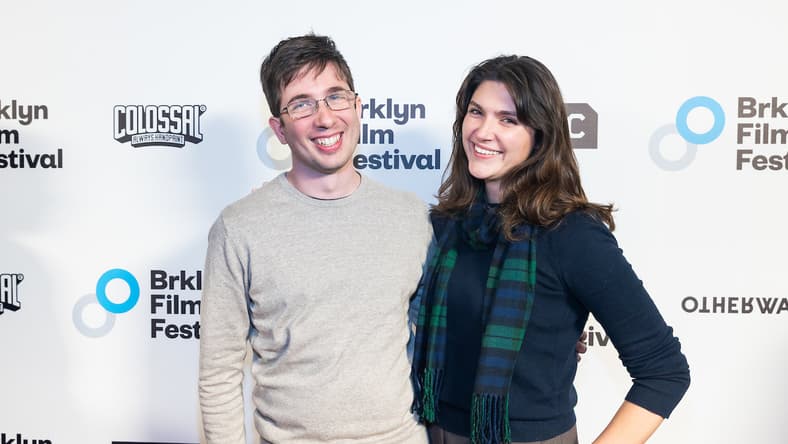
Five years after graduating from the Savannah College of Art and Design (SCAD), Emily Dillard and Nico Rinciari are bringing their first feature film to theaters.
Adapted from Andrea Ferraris’ graphic novel Una Zanzara nell’Orecchio, A Mosquito in the Ear follows an American couple traveling to India to adopt a young girl who is reluctant to leave the orphanage she calls home.
Starring Jake Lacy (The White Lotus), Nazanin Boniadi (The Lord of the Rings: The Rings of Power) and newcomer Ruhi Pal, the independent drama was shot on location in Goa, India, and marks the feature debut for the married filmmaking team.

The film is also the culmination of a creative partnership that began at SCAD. Dillard and Rinciari met while studying Film and Television and graduated together in 2020. During their time at the university, they collaborated on several projects, including Our Side, which earned a College Television Award Emmy.
More than a dozen SCAD alumni and faculty members would eventually contribute to A Mosquito in the Ear, including director of photography Kai Dixon, editors Devon Souwold and Harrison Cratch, producer and sound designer Matt Yocum, and faculty members Stephen Stanley and Frank Hall Green.
By the time Dillard and Rinciari arrived in India to begin principal photography in 2024, they had already spent years living with the story.
Rinciari first discovered Ferraris’ graphic novel through a publishing list and immediately connected with its themes.
“I fell in love with it,” the director says. “It resonated with a lot of the themes and a lot of the aspects of life and intercultural relationships that I was dealing with, also in my own personal life.”
He brought the book to Dillard, who was immediately on board. When they discovered the film rights were still available, they opened conversations with Ferraris and eventually traveled to Milan to meet with the author and his family in-person.
“What really made the difference is flying to Milan to have lunch with the author and his family,” says Dillard. “We had a wholesome conversation, because of course it’s their story as well.”
Those meetings helped shape the adaptation, which the couple co-wrote. While the graphic novel served as the foundation, conversations with Ferraris and his family revealed details and experiences that never appeared on the page.

The filmmakers also gained access to a valuable resource: hours of documentary footage shot by Ferraris at the time of the adoption. The material became one of the project’s most important creative references.
“We watched it all and looked at all to understand what the feel was,” says Rinciari. “In some ways when someone shoots or takes a picture, you can see what they’re fascinated by, what their interest is.”
Rather than simply using the footage for research, the filmmakers studied it to understand how the family experienced India. Certain shots inspired entire sequences, while others were recreated directly for the film. Original footage of the real family is also included at the end of the film.
“There were moments not just of shots that we created after a photograph or a piece of documentary footage that the father had shot,” says Rinciari. “We would see, okay, this is the moment where that picture that he took can relive, and we can bring it in with movement on screen.”
One photograph of the family’s daughter looking back over her shoulder was recreated with nearly identical framing.
“We tried to capture it, even with the same framing, because we wanted that feel,” he says.
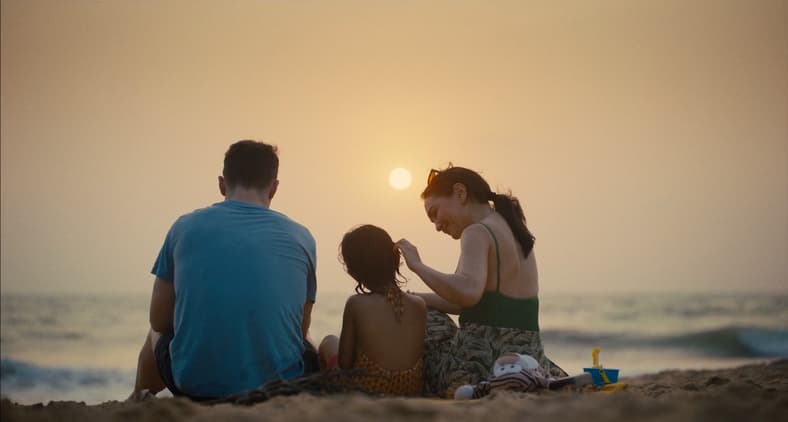
That commitment to authenticity extended to the production itself. The filmmakers shot on location in Goa and worked closely with Indian production partner Les Sutra Pictures to navigate permits, locations and local crew hires.
The collaboration also gave the filmmakers access to department heads who could help ground the story in the culture and locations it portrays, which Rinciari says was essential for authenticity.
The approach proved particularly important during large crowd sequences, including scenes in which the young girl becomes separated from her family. While some footage was captured documentary-style in real locations, other moments were carefully staged with large numbers of extras.
“A lot of that is a good mix of B-roll footage taken, or just guerrilla-style taken in the real place,” says Rinciari. “But a lot of it is also staged with extras, 130 extras.”
Finding a young actor capable of carrying those scenes proved challenging. After reviewing hundreds of auditions and expanding their search shortly before filming, the team cast newcomer Ruhi Pal.
“She just had a soul behind her eyes,” says Rinciari. “She wasn’t acting per se, she was playing pretend with us.”
While A Mosquito in the Ear is their first feature, Dillard and Rinciari weren’t making it alone. Throughout development, production and post-production, they continued to lean on relationships formed at SCAD.
Stanley became an important mentor as the filmmakers navigated financing and business decisions.
“I would email him like a list of 20 questions every week,” says Dillard.
Meanwhile, many of the collaborators who had worked with the pair on student films returned for the feature. For Rinciari, bringing together former classmates and longtime creative partners felt less like assembling a crew and more like a reunion.
“It was just a homecoming,” he says.
That sense of community extended into post-production. The sound mix was completed at SCAD with Yocum leading the process, creating another opportunity for the filmmakers to return to the place where their partnership began.
Looking back, both filmmakers describe the project as the product of years of collaboration, mentorship and trust. What started as a graphic novel discovered on a publishing list eventually became an international production involving artists and supporters across multiple continents.
For Rinciari, one moment stands above the rest. After watching the finished film, the real family told the filmmakers they felt as though they were back in India reliving their experiences.
“That was for us the biggest compliment,” he says.
Main image: A Mosquito in the Earfilmmakers Nico Rinciari, left, and Emily Dillard. Courtesy of Brooklyn Film Festival.
Editor’s Note: Adds photos.