
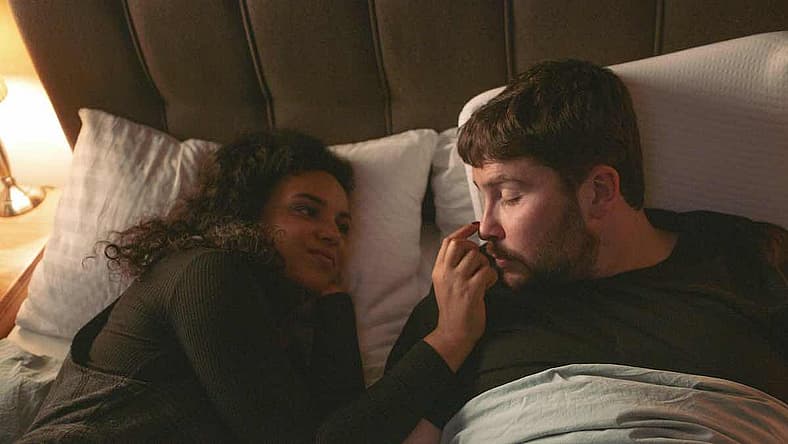
Dean Leon Anderson isn’t sure if the job in his short film “The Mediator” really exists — but if it doesn’t, it should. The film tells the story of a woman named Mary, played by Cat White, who is hired to help a man with quadriplegia try to repair the broken relationships in his life.
“A person who mediates emotionally messy conversations between people who can’t face each other? I’d hire one in a second,” Anderson tells MovieMaker. “Maybe I need to start my own agency. The idea came from wondering what would happen if someone literally outsourced their most difficult relationship — the kind of conversation that feels impossible to have without a buffer.”
The film, which plays Saturday at the Santa Fe International Film Festival, where Anderson will also take part in a post-screening Q&A, also stars Daniel Portman as Chris, the man who needs a mediator, and Mia Tomlinson as Olivia, his long-suffering sister.
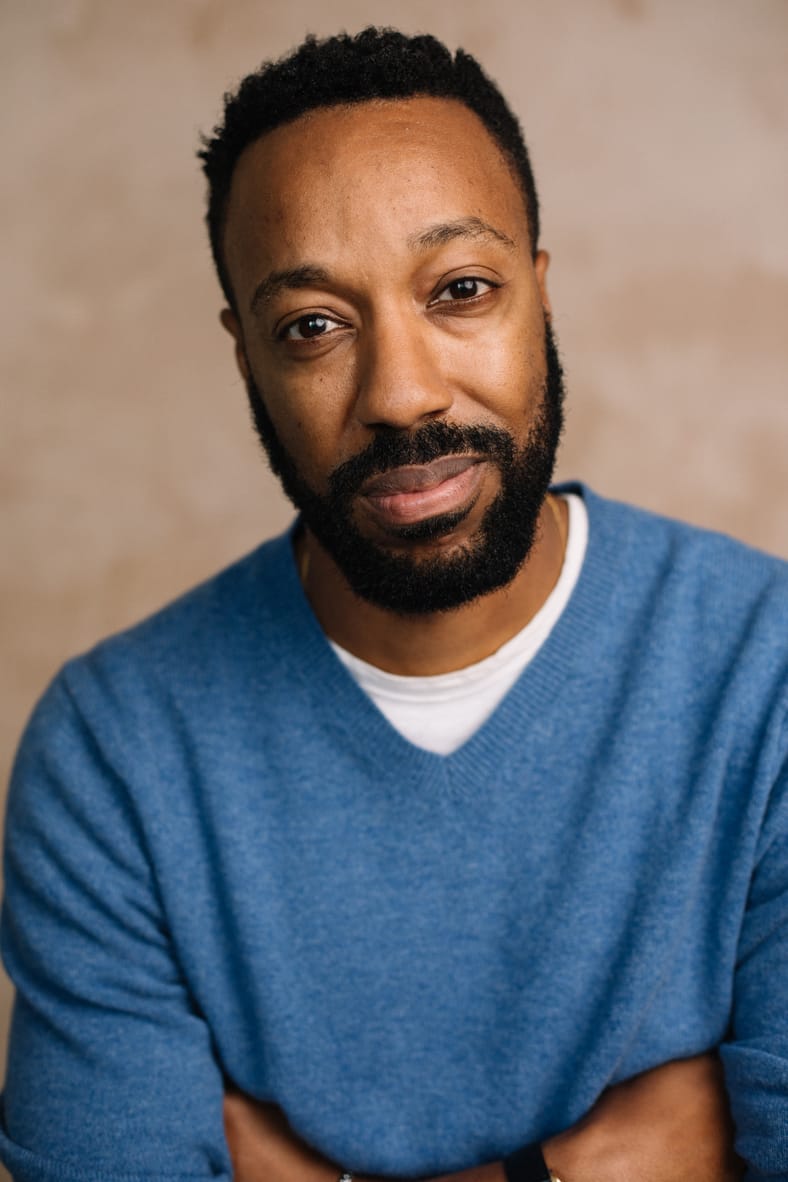
Anderson is a British writer‑director who focuses on emotionally grounded, character‑driven films, including 2020’s “My Time With Joe” and 2016’s “Class 15.” We talked with him about emotionally stilted characters, structure, and whether the mediator of “The Mediator” is who she seems to be.
MovieMaker: How did you become a filmmaker?
Dean Leon Anderson: I’ve always loved films, but for a long time I had no idea how to actually become a filmmaker. It felt like this far-off, mysterious world, growing up in South London. Things really started when a friend received some funding from BBC Films to make a short, and I asked if I could help. I ended up assisting his producer and just absorbed everything I could on his set. That experience lit the fire. I went off and started writing my own scripts right after.
I didn’t have access to funding at first, so I cobbled things together — self-funding, borrowing kit, convincing friends and family to get involved. It was very DIY, but I learned a lot from doing it that way. After a few shorts, I started getting proper support for my work, and things grew from there. It’s been a gradual process, built on momentum and a lot of persistence.
MovieMaker: Can you talk about finding your excellent actors?
Dean Leon Anderson: I was lucky enough to work with Sharon Duncan-Brewster (Dune, Sex Education) on my previous short, “Class 15.” I thought I’d written a solid script, but she brought so much depth to her character that it completely raised the bar for how I approached casting “The Mediator.” The characters in this film are complex, and I knew I needed two strong leads who wouldn’t just play what was on the page, but would bring their own instincts and challenge the material in the best way.
I met casting director Zyrenka Cox through a BAFTA film scheme, and it was perfect timing. I’d originally pictured older actors in the roles, but her suggestions completely reshaped my thinking, in a good way. She put forward Daniel Portman [Game of Thrones], Mia Tomlinson [The Beast Must Die], and Cat White [Ten Percent], and I immediately saw the potential.
I already knew Daniel’s work, and after talking it through with Zyrenka, I knew he was right for Chris. I auditioned a few actors for Mary, but Cat stood out from the start. I’d seen Gina Bramhill in The Flatshare and was drawn to her subtlety, and Ian Burfield [EastEnders, The Selfish Giant] has a voice that instantly grounded his character. I was very lucky when they all came on board.
Dean Leon Anderson on the Untold Backstory of ‘The Mediator’
MovieMaker: Why did you want to tell this story?
Dean Leon Anderson: After making “Class 15,” which was set in a classroom during a parents’ evening, I became really interested in creating stories within intimate, contained spaces. “Class 15” started off polite and civil, and gradually descended into chaos. With “The Mediator,” I wanted to flip that structure — to start in a place of real hostility, with two people who are completely shut off emotionally from one another, and see if they could find a way to something more human.
I’m drawn to characters who are emotionally stuck, and to situations where communication has broken down. There’s something interesting in seeing what happens when you force people into a room, or even a phone call and they have no choice but to face what’s gone unsaid.
MovieMaker: Can you talk about your use of elegant cuts to black to show the passage of time?
Dean Leon Anderson: Originally, the script had a chapter structure. Each shift in time came with a title and time of day, to mark how long the characters had been in the space together. I’d been inspired by Joachim Trier, whose films often play with structure in inventive ways. I wanted to experiment with something similar, especially since the story plays out over a 24-hour period.
But during post production, once we’d cleared all the graphics for color grading and I got the final graded files back, I realized the clean cuts to black were doing all the work I needed. Paired with the lighting changes and shifts in mood, it still clearly showed the passage of time — and actually gave the film a more restrained, mature feel. So I ended up using my instincts and keeping it simple. Sometimes less really is more.

MovieMaker: [Spoiler warning] Why does the mediator seem to develop such warm feelings for this surly man? To me, the film seems to leave open the question of whether she’s actually a mediator, or if the sister has just enlisted her to try to break her brother from his cycle of self-pity.
Dean Leon Anderson: That’s such an interesting observation — and you’re not the first to float that theory! I’ve actually been asked a few times whether I’d consider expanding this world, and if I did, I think it would begin with Mary’s backstory.
She’s such a unique presence. To me, she’s like this quiet knight in shining armor, someone who steps into people’s emotional chaos to help clean it up. I even took her name from Mary Poppins, who famously arrives in the Banks’ lives to sort things out when everything else seems broken. But underneath Mary’s calm, there’s a lot of baggage.
I think part of why she connects with Chris is that, in staying longer than she probably intended, he ends up being one of the few people who actually listens to her. They’re very different people, with very different issues, but in that moment, there’s a kind of mutual recognition, two stuck people seeing something human in each other. I won’t say much more for those who haven’t seen the film yet, but I really like your take. That ambiguity is kind of the point.
MovieMaker: Finally, what’s the biggest obstacle you faced in making this film, and how did you overcome it?
Dean Leon Anderson: The biggest obstacle was definitely the lack of external funding. “The Mediator” was entirely self‑funded, which limits what you can do, but it also sharpens your focus. With no script development schemes or external partners involved, every decision had to be intentional and achievable with the resources I had.
At the same time, I was in early‑stage development of my debut feature with the BFI Network, so “The Mediator” became a kind of creative reset, something I could fully own and make on my own terms in the middle of a much longer, more complex process.
Taking on multiple roles, writing, directing, producing, and editing was both freeing and exhausting. I did this because it was important to me that the film felt authentic and intimate, and that nothing got overworked or diluted. I surrounded myself with amazing and experienced collaborators I really trusted, and they made all the difference. Though it was a challenge, it reminded me of why I started making films in the first place: just telling stories in the purest way I can.
“The Mediator” screens Saturday at the Santa Fe International Film Festival, one of our 50 Film Festivals Worth the Entry Fee. You can read more of our festival coverage here.
Main image: Daniel Portman and Cat White in “The Mediator.” Courtesy of Dean Leon Anderson.