

Heather Mason has worked extensively with prestigious film festivals and wealthy foundations looking to invest big philanthropic budgets. She brings them both together at The Impact Lounge, a place where changemakers meet filmmakers and creatives.
Since its debut at the 2024 Sundance Film Festival, the Impact Lounge has been a moveable space that hosts panels and discussions at some of the most celebrated festivals in the world. Months before each event, she and her team seek out locations with just the right mix of comfort and elegance. They want people to be relaxed enough for serious talks.
“Our entire mission is to bring together changemakers, filmmakers, and creators for three things: conversation, connection, and collaboration,” says Mason, the Impact Lounge CEO and founder.
She hopes her gatherings will help build a film ecosystem in which filmmakers turn to philanthropists as an alternative or in addition to studios to finance their work, so that films, TV shows and online stories can help shape a better world.

That egalitarian approach includes making Impact Lounge events accessible and open to all.
Mason notes that you don’t need a high-level badge to visit the Impact Lounge: You just need a genuine desire to make a difference.
“The only time we’ll turn you down is if we’re at fire capacity, and I think that really sets a tone, especially at what seem to be very closed locations like film festivals or other types of festivals,” she says. “We want to be the place you can call home, get inspired, and learn, and of course you’ll get some snacks and beverages. And I think it sets a tone for everyone coming in to not put on airs and instead talk about things that matter.”
The Impact Lounge is holding two events at the Tribeca Festival this week, as part of a packed 2026 calendar: It has also hosted events at the Sundance and Cannes film festivals, and plans more events later this month at the Cannes Lions Festival of Creativity and the Aspen Ideas Festival.
How Heather Mason Started The Impact Lounge
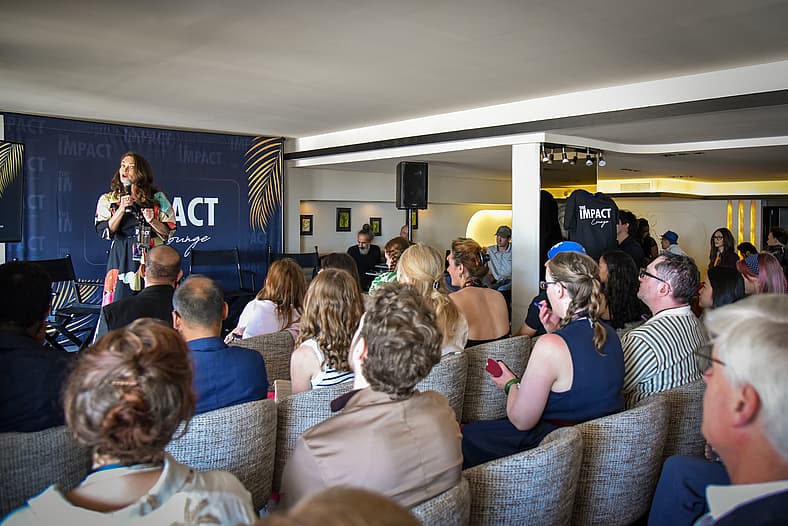
Mason’s work with festivals started when she volunteered for Sundance in 1994. She was soon hired by Julie Sisk’s American Pavillion at Cannes. She went on to work for Fox Studios before transitioning to events and founding the Caspian Agency in 2005, which provides scientifically-based strategies to plan events for well-funded clients including the Skoll World Forum, Omidyar Network, Rockefeller Foundation, and Ford Foundation, among others.
Mason observed that many of her clients offer grants for grassroots work, but they are not always focused on removing what she calls “cultural boulders” — norms, customs or prejudices that can slow the pace of progress. Removing such boulders, she notes, “usually happens through our stories, our heroes, our villains, our myths, our legends.”
So she decided to bring together filmmakers who always need money with nonprofit financiers looking for smart ways to spend it.
Imagine, for example, a nonprofit trying to reduce unwanted teen pregnancies. It could fund countless pamphlets and PSAs that might go ignored. Or it could fund a TV show, movie or vertical that makes all the same points, while keeping audiences laughing, crying, and caring.

Mason stresses an analytical approach with her Caspian Agency clients, and Impact Lounge events follow suit. The focus is on not just dreams, but results.
A recent panel at the Cannes Impact Lounge, for example, included a representative of the World Bank — which fights poverty around the globe through leveraged loans in developing countries. Panelists discussed a recent AI analysis of reality shows in Nairobi and Kenya, and how the shows’ portrayals affected viewers’ perceptions of entrepreneurial women.
It was a technical and engaging discussion of how pop culture, honed by analysis, can be a tool to fight global poverty. But the medicine went down easy in the serene Impact Lounge setting, the elegant La Muse bistro, across the street from the beach. Guests could ponder data-driven solutions while sipping cocktails, eating canapes and glancing out the tall windows at a perfect blue sky. Impact Panel events never feel rushed or overstuffed, so guests have time to go deep on new and inventive ideas.
Mason calls this approach “spinach in the popcorn,” and she lives by it: She’s a screenwriter on the side, with a raucous, charming rom-com screenplay called Love By Proxy that works in a pragmatic environmental message. It’s the rare script that would delight Lifetime audiences and land preservationists.
Mason is able to attract Impact Lounge participants like the World Bank thanks in part to her longstanding contacts through the Caspian Agency, which she established in 2005. The success of Caspian, a for-profit, enabled her to start the non-profit Impact Lounge.
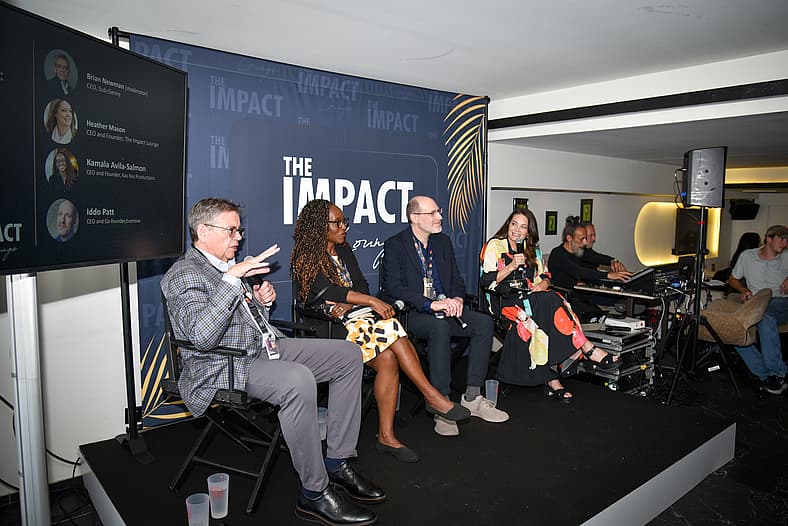
Funders for the Impact Lounge include the UTA Foundation, the Doris Duke Foundation, and, she quips, “Heather Mason’s retirement.”
She defines impact broadly, to describe films that make an impact with their subject matter — like documentaries and socially-conscious features — but also projects that are made in a sustainable way, or that employ new people.
A rom-com or fantasy that just wants to entertain could meet the definition of an impact film, for example, if it were made in an environmentally conscious way — or if it gave opportunities to underrepresented filmmakers.
And while the Impact Lounge is currently about providing a place for people to connect and collaborate, Mason believes it could help lead to an “impact studio system,” in which filmmakers turn to philanthropic capital and alternative funds to finance their films.

While studios may be afraid of anything that feels political or socially conscious, that might be exactly the kind of material that makes sense for a nonprofit.
“I do think eventually we will be a place where people can have the opportunity within this ecosystem to understand how to fund, how to find an audience, how to get distribution — everything that needs to happen to encourage the creation of an impact studio system,” Mason explains. “This system could be funded almost entirely with philanthropic capital, and then you can add in brand capital, from brands that want to make an impact.
“You now have enough capital to create that alternative impact studio system. I think we can encourage and foment that by creating these lounges,” she says. “It just has to be connected, and that’s the purpose we serve, as a consistent connecting point.”
You can catch The Impact Lounge next at Cannes Lions, during the Aspen Ideas Festival and at the United Nations in the fall. And you can learn more about the Impact Lounge here.
All photos by Bruno de Marquis, courtesy of The Impact Lounge.