

In 2013, Eddy Moon, Ronald Baez, Kevin Ondarza and Ashley Rose were South Florida filmmakers struggling to make movies. Since they weren’t getting support from Hollywood, they decided to support each other and fellow local creatives by founding White Elephant Group, a production house and nonprofit dedicated to incubating projects for underserved emerging moviemakers.
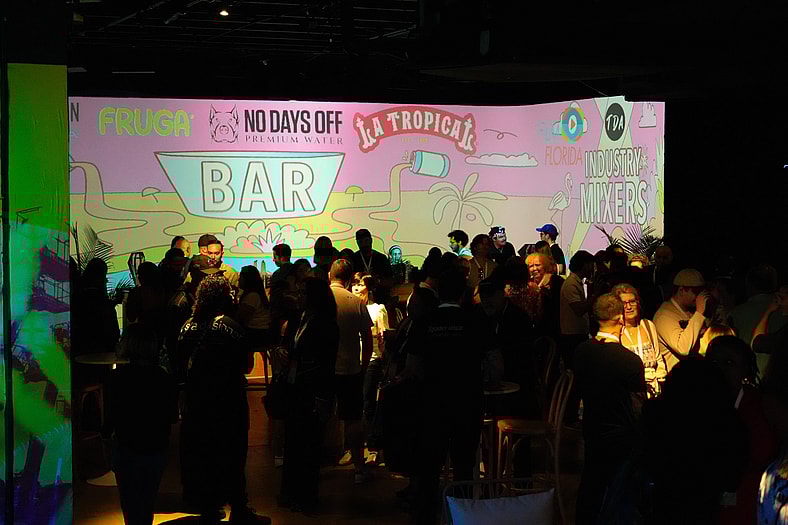
Since then, WEG has produced several feature films, screened projects at 200 festivals including Tribeca, Slamdance, and the Miami Film Festival, and handed out roughly $250,000 to South Florida projects. This past weekend, their success was on vibrant display at the South Florida Film Forum, a packed gathering of panels, workshops and parties. WEG produces the event in partnership with Broward County, Film Lauderdale and MAD Arts.
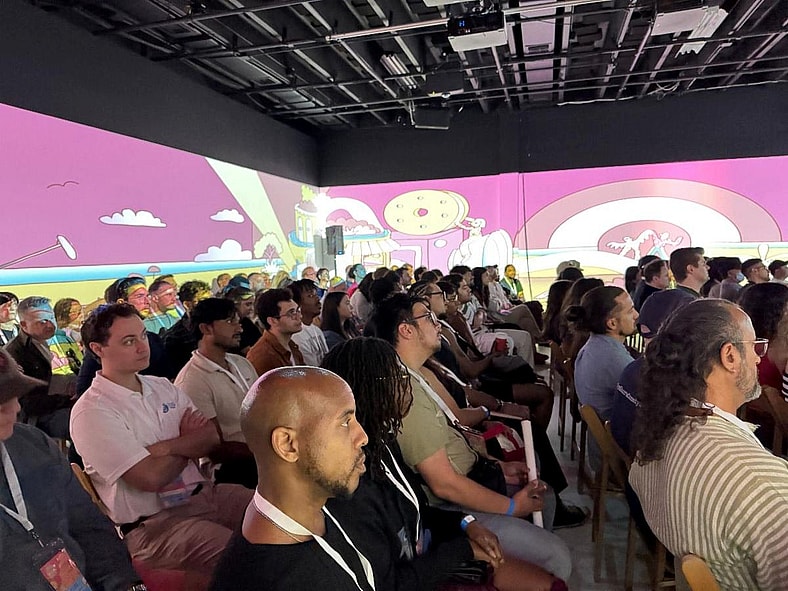
About a thousand artists — including actors, producers, writers and directors — packed the dreamy MAD Arts immersive arts museum to talk about the state of filmmaking in the area. MovieMaker was honored to be in attendance, and to learn more about a fast-to-adapt film community.
The energy was high — so high that a workshop on the fairly niche subject of how to distress wardrobe got a burst of applause so loud you could hear it down the hall. (Respect to the workshop’s leader, Logan Moises, a costume designer whose credits include the locally shot Apple TV show Bad Monkey.)

South Florida’s film and TV industry is sustained by commercial work, but the region also gets its share of big movie and TV productions. (On the weekend of the Film Forum, for example, ABC’s series RJ Decker happened to be shooting in town.) The area also has a sizable share of influencers, and, perhaps most importantly, indie producers working on self-generated projects like those taken on by the White Elephant team.
Many at the Film Forum were working on or planning their own projects, while paying the bills with studio work. So they had a stake in South Florida both continuing to draw industry employers, and fostering a community that rewards creativity and drive.
The South Florida Film Forum panels were generally off the record, but we got permission from several participants to share the following takeaways from their talks. They range from from big-picture industry trends on verticals and AI to very specific pieces of advice that will help local actors. For the off-the-record detail, we recommend attending in person.
Advantages of South Florida
Fort Lauderdale is one of the top cities on MovieMaker‘s latest list of the Best Places to Live and Work as a MovieMaker, thanks to busy shooting schedule, diverse locations, strong local incentives, and a diversity of productions.
Marlis Pujol, a producer who has worked on shows including Mythic Quest, Ballers, True Blood, The Wire and The Sopranos, noted that the weather in South Florida is so mild that when she worked on a season of HBO’s Ballers just over a decade ago, the show could shoot almost everything outdoors, with no sound stages.
“We were able to really showcase Miami, Fort, Lauderdale, everywhere that we filmed,” she said. “We did not have a studio. We shot on location the entire season, and the Florida weather was so amazing.”
There was only one day of rain, and that was on a day the show was already scheduled to shoot indoors.
Though statewide incentives were discontinued a decade ago, local commissions like Film Lauderdale have stepped up in a big way to keep production going strong. Broward County offers up to 30% in rebates, and the county also offers a $10,000 Emerging Filmmakers Grant to support resident filmmakers on the rise.
Fort Lauderdale film commissioner Sandy Lighterman also leads Film Florida, a nonprofit devoted to building a robust and retentive film industry in the Sunshine State.
Take Risks
One recurring piece of advice was for creatives to take big swings and create their own stories instead of waiting around, hoping for a greenlight from above.
Miami-based producer and showrunner Eric Gaunaurd noted that the industry has made tremendous progress in de-risking projects, or reducing the potential for losses. Producers have tried, for example, to establish built-in audiences by casting stars with large followings online.
But at times, all that de-risking has made projects feel too safe, he said.
“You’re all about mitigating your risk, but you have to find your balance,” Gaunaurd explained. “What’s happened a lot in the system over the last, I think, 5 to 10, years, is there’s been too much of a focus of mitigating risk. Some of the best films you’ve ever seen came from people who were bold, and they took creative risks… you don’t see as much of that anymore, but it’s still happening.”
Vertical Pros and Cons
Verticals came up often at the South Florida Film Forum, including in a Saturday evening panel on Distribution in a Digital Age.
For the uninitiated, verticals are long-form stories broken into short segments and created for phones.
As a medium, they got off to a rocky start with Quibi, a short-lived streaming service founded by Jeffrey Katzenberg and led by Meg Whitman that offered vertical stories and failed for a number of reasons. It raised more than $1.75 billion from investors, but spent splashily on lucrative payments to creators, then generated a lack of interest among audiences.
Today’s verticals are different. They’re often relationship- or romance-oriented, and are often distributed on platforms like ReelShort, which provide a few episodes for free, with the rest behind a paywall. Most episodes are a couple of minutes long.
Big payments for creators and stars have mostly gone the way of Quibi. Though verticals provide welcome, steady work for many actors and filmmakers, the productions are typically non-union and low-budget, with commensurate low payment.
Gaunaurd noted that most producers want to be paid well, or at least proud of their work creatively. “If I’m not making money in a project, it better be creatively just amazing,” he said.
One way to make verticals profitable is through volume, he said — packaging several vertical projects together with a well-established partner. He said verticals can be worthwhile “if you have multiple projects in mind that maybe you can find financing for — or you can partner up with the ReelShort or one of these other companies that are producing those, and take a few projects to them.”
Incentives Are Essential
Daleen Buter, head of Global Production Incentives at Prime Video and Amazon MGM Studios, noted that incentives have become much more essential to film and TV.
“When I started in 2012 at Warner Brothers, in features, we were probably making 85 to 90% of our films with incentives,” Buter said. “Now I don’t speak for my Warner Brothers, because I’m not there, but I can say at Amazon, it’s 100%. There’s no project that is being made on the series side or the feature side that doesn’t have some kind of incentive. And often I have four to five incentives on one project to manage.”
Additionally, several speakers called for a nationwide film tax incentive to help bring productions that have fled overseas back to the United States.
Be Flexible
Filmmakers and showrunners should be flexible if they want to get things made, Buter noted. If filmmakers are wedded to a particular location, for example, they have less chance of getting their project made, because incentives may not be strong in that region.
“The ones that I work with that have the most flexibility and willingness to hear what people have to say are usually the most successful,” she noted. “The people we work with the best, whether it’s in series or movies, are those who say, ‘This is my script. This is my project. But you want to hear what you have to say as well.'”
Tourism and Film Should Be Friends
Joe Chianese, the senior vice president and practice leader on production incentives for Entertainment Partners, said film commissions should work hand-in-hand with tourism departments to attract projects that will entice visitors.
That’s especially true in a place like Florida, known for blue skies and beaches. And the projects don’t have to be features or TV shows, he noted — commercials and reality shows can also draw tourism.
“I tell film commissions to talk to their tourism department, because it just makes so much sense. I mean, think about Real Housewives — those are commercials to go to New York City,” he said. “There’s a Real Housewives of Rhode Island. Now there’s a London one. They’re really commercials for tourism at the end of the day.”
AI Is Popping Up in Post
Many audience questions focused on AI, and whether it could replace human jobs. The consensus was yes — but maybe not in the way people fear.
Pujol said she hasn’t seen AI being used to create scripts, but does see it being used in post-production, to help assistant editors organize footage for editing, for example. She said they don’t use AI to make cuts, but could use it for something like comparing clips. She had understandably mixed feelings.
“It hasn’t quite made its way into my production world yet,” she said. “I say yet, because, you know, at some point we’re going to find ways to bring it in there.”
Negotiate to Protect Your Job From AI
The recent writers and actors’ strikes put many protections in place to prevent AI from replacing union members. But AI is being used, for example, to reduce background work for actors on non-union jobs.
All non-union actors need to read their contracts carefully, because in some cases they sign documents without realizing they’re consenting to having their faces scanned and used in ways they didn’t anticipate. An actor could be unwittingly duplicated into numerous crowd scenes, for example.
“Non-union jobs will sneak it into the contract,” said Kelly Vaughn, president of the SAG-AFTRA Miami Local Board, during a panel called SAG-AFTRA 101.
Micheel Viera, executive director of the SAG-AFTRA’s Miami Local, said such productions will often sneak it into the “Work for Hire” section of a contract. So if you’re a non-union actor, you should read your contract — but especially the Work for Hire section.
Kelly Paige, a talent agent who is the owner and president of Level Talent Group, noted that union acting contracts typically have standard provisions about how actors’ images can and can’t be used. She said that when a big production recently planned to use AI on actors’ faces, “they sent us a separate rider for AI that spelled out everything that they were going to intend to do with our actors image.”
She welcomed the level of detail.
“With AI, I was concerned,” she said. “But they’ve done a great job in spelling out everything.”
Viera said that while many would love to just ban AI, it isn’t going to happen — so creators need to get ahead of the technology, and negotiate to protect themselves. He noted that creators have had to adjust to past paradigm shifts, including the advent of TV, home video, and streaming.
“We know that change is inevitable, and we acknowledge it. We don’t ignore it. So we have to come to the table with these people and deal with it and contend with it,” he said.
Advice for South Florida Actors on the Rise
This might sound surprising, coming from the executive director of the SAG-AFTRA’s Miami Local, but Viera doesn’t think actors need to join SAG-AFTRA at the start of their careers. He suggests they gain experience first on non-union productions.
“I think that you should do non-union work in the beginning, because it’s a great rehearsal for you guys to become really good actors, and you gain so much experience doing that,” said Viera. “Eventually, when you go through your career, you’ll want more, and it’s OK to ask for more.”
He said that while non-union jobs will never pay as well as union jobs, you can learn a lot.
“So, do a bunch of non-union projects. That’s where you’re going to meet people. You’re going to know how to be on a set, know what your marks are, know what good lighting is, know where the camera is. That’s where you’re going to learn all that stuff,” he said. “But eventually, when you’re ready to take the next step, when you’re ready to invest in yourself and say, ‘Hey, I’m going to leave that non-union work behind, because now I want more money, because I’ve had all this experience behind me’ — that’s when you decide to go union.”
He shared that the national rate to join SAG-AFTRA is $3,121, and the local rate is $1,873. Payment plans are available, and membership means better pay, more protection on projects, and health care access. One benefit people often forget is access to the SAG-AFTRA credit union, which can offer loans.
While you don’t need to be in SAG-AFTRA at the beginning, Vaughn urged actors to find an agent as soon as possible if they want to work regularly in South Florida.
“You need an agent here, because most people, when they’re casting something, they want it to be turnkey,” she said. “This is an industry of relationships… Casting directors have relationships with certain agents, and so they say, ‘What have you got today? Show me your roster.'”
And as lovely as the winters are in South Florida, the summers get hot. Most productions take that into account and ensure the comfort of their casts and crews. But Viera and Vaughn noted that actors who are uncomfortable in the heat can ask the unit production manager for a remedy — such as tents. (If they don’t want to ask the UPM, they can ask a PA to ask the UPM.) If all else fails, they can always call SAG-AFTRA’s 24-hour safety line, which is (844) 723-3773.
South Florida Film Forum Advice on How to Impress Investors
A Sunday evening panel on Film Financing and Global Incentives provided solid insights on how to get funding for your self-generated projects.
Leonidas Oxby, a Miami-based managing partner at Brickell Capital Finance who helps connect filmmakers with family offices, high-net worth individuals and other potential investors, said many of them are interested in film both for creative reasons, and to reduce their taxes.
When he agrees to work with filmmakers, he makes sure they have professional decks and impressive examples of their work. But they also need to know how to present themselves.
“Set realistic expectations. Know your audience. Have a really solid cast, have a really solid director in place,” Leonidas said. “People interested in investing are very savvy individuals. They understand how risky the business is, and they can smell whether you’re telling a story or whether you’re being realistic and honest. So don’t make something up or what you think they want to hear. Tell the truth.”
Many South Florida Film Festival panelists stressed the importance of being honest, but Viera put it best:
“You can do good business your whole life,” he said. “You can do bad business once.”
You can learn more about the South Florida Film Forum here, White Elephant Group here, and Film Lauderdale here.
Main image: A packed panel at the South Florida Film Forum. Photo by Sandy Lighterman / Film Lauderdale.