
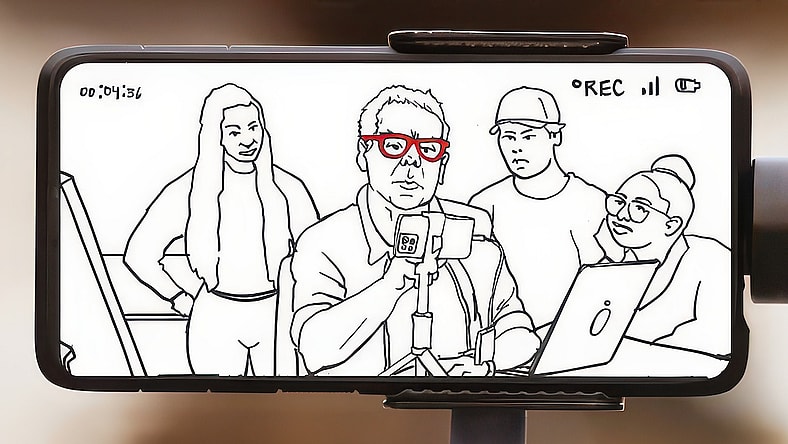
Bart Weiss is a filmmaker, recently retired film professor at the University of Texas at Arlington, and the author of Smartphone Cinema: Making Great Films With Your Mobile Phone, a detailed how-to guide on best practices for shooting movies on your phone. In the excerpt below, he lays out the arguments for and against smartphone filmmaking — and explains why the objections are sometimes just excuses. Smartphone Cinema is available now from Focal Press. —M.M.
THE CASE FOR SHOOTING MOVIES ON YOUR PHONE

There are many good reasons to tell cinematic stories with your phone.
1. It’s Cheaper: You already own a phone, so you don’t have to pay for an expensive camera or other high-end gear. While you might purchase microphones, lights, and additional support to have more control over your shooting on mobile phones, it will still be much less than buying a 4K cinema camera. Not spending money on your camera can free up money to pay for better actors, more props, and art direction on your sets, or let you shoot in visually exciting and dramatic locations. Or it might just mean that you can make a film instead of just talking about making that film. We have killed the excuse that “I could make this film if I only had more money.” You can use the camera on the phone in your hand.
2. Better Performances: You can get better performances, which can help you make a different kind of film. Because the mobile device is small, you can get closer to your subjects or actors. For example, when making a documentary, you want the subjects in your film to open up and tell you what is really going on. Getting to that deeper emotional place is more challenging with a big crew and lights. The phone allows and encourages more intimacy. It can be just you and the subject. I have been working on a music doc, and my subject has been much freer and more expressive when filming on the phone than with a full crew. Once you learn how to control the picture and sound on the phone, you can focus on what is in front of the camera. If you are new to filmmaking, the native apps on your phone will give you a good image with less anxiety. If you are an experienced filmmaker, you can have all the control you need.
This intimacy also works for fiction films. In High Flying Bird, which Steven Soderbergh shot with his phone, there is a production still of just him and two of the actors. This is a Hollywood film that usually has an army of people, complete with the stress, drama, and expense that goes along with an army.
Imagine the level of closeness and intimacy the use of your phone provides — more like a profound and moving conversation you had with a close friend than a public performance in front of that army of crew. Capturing that kind of performance will foster a connection with an audience.
Because you can make a film for less money using your phone, people from marginalized communities can be represented and portrayed in films that they can make themselves. The world is better when more diverse filmmakers can emerge, so that audiences can learn about their lives, their dreams, and their pain.
3. You Can Shoot Differently, With More Agility in More Places: Since the phone is lighter and smaller than a traditional camera, you can move it around differently. You can be bolder and move the camera as the moment inspires you. You can improvise. You have even more options when you carefully plan your shots. Get creative! You can put the phone in a jar and shoot underwater (really, you can!). Basic camera shots are much easier with the phone. For example, with your phone, you can shoot in a car much more easily than by getting a car mount or trying to fit a large camera set-up into the vehicle. You can hop from the front seat to the back seat or mount it on the dashboard.
4. It’s more fun: Yes, shooting with a mobile device is joyous! Why? Pulling out your phone and creating on the spot, spontaneously and effortlessly, is more freeing than all the work required to organize and put together massive amounts of equipment. At least, I think so. We all need more joy in our lives and in our art-making practice.
THE CASE AGAINST SHOOTING MOVIES ON YOUR PHONE

In the history of filmmaking, some filmmakers have embraced new technologies while others have scorned them. In the early days of filmmaking, motor-controlled cameras became available (instead of hand-cranked ones). Still, camerapersons did not want them because they thought their skill was to manually crank the camera at precisely 18 frames a second, and they thought the motor would put them out of business. Some people with special skills do not want a world where those skills are no longer required.
Another reason some resist the mobile wave is that they believe its images are not as good as with traditional media, and it is not “professional.” Filmmakers with years of experience using expensive, complex cameras don’t want to waste their years of developing their craft. The reality of mobile filmmaking is that you can succeed at any stage of your filmmaking development. Modern phones can give you a good image using the native app. As you get more experienced, you can create better work, but from day one, you can use your phone to tell a cinematic, professional-looking story.
While you can have a good image shot with the native app, there is much craft to constructing a good image on a phone. Good phones from Apple, Sony, and Samsung have excellent resolution and camera control. There is a shift in how camera people work with a lens to create a look, and how mobile filmmaking can use the computer in the camera to control the image.
The mobile phone is a studio in a tiny box. In the history of image making, this is the first time we have had a tool like this. Its camera can record still pictures, motion pictures, and audio. It can measure distance (with lidar). It is a high-quality display device.
It is also connected to the internet, meaning you can send or broadcast your videos. You can also edit your videos on the phone. Aside from image-creating and displaying devices, you can also use it to send a text and talk. You can use apps on the phone to help organize your production and even tell you when the sun is going down.
One downside of mobile filmmaking is removing your excuse for not making a film because you are waiting for money.
When I started making films, 16mm film was expensive to shoot, develop, and edit. That meant you had to have money or a grant to make a film. So only certain people made films, and only certain films were made.
Now, you can do it, and you will do it.
There are a few reasons not to shoot movies on your phone, so let’s get them out of the way. While we can have all kinds of cages, mounts, and gimbals, phones are shaped to be phones and are not so easy to hold in your hand. While the phone is unnatural for handholding, you can get steady with practice.
The second issue is lenses. A good lens for a digital cinema camera can cost more than your phone does. An excellent digital cinema lens is sharper and more controllable. Mobile phones make up for this with the supercomputer in your hand that can interpolate between the lenses and manipulate the image in a way a camera alone cannot.
Another problem with mobile lenses is that it’s easy to get dirt on them.
We keep them in our pockets, and they also get smudgy. So, keep some lens cleaner in your pocket and clean your lens gently, rubbing it in circles. You can use a lens cloth or wipes (I like the Zeiss ones). You can also get lens caps to keep the lenses from getting scratched, which is a good idea.
For some people, ego is an issue. Filmmakers like to pride themselves on having cool and expensive gear. This is okay if you can afford it, but realize you can make great films with your phone, and don’t let anybody with a big camera shame you.
While they are setting up, you can get three shots off! This attitude has been with us since 16mm film and with every other “amateur” format that has surfaced.
One of the great things about mobile media is that you can use it at whatever skill level you have. If you have not shot anything more than selfies and videos of your friends and family, you can use the native apps with the phone, and it will work like a point-and-shoot camera, but with practice and intentional shooting, you will learn to make better films.
You can purchase Bart Weiss’ Smartphone Cinema: Making Great Films With Your Mobile Phone here or at other retailers, from Focal Press.