
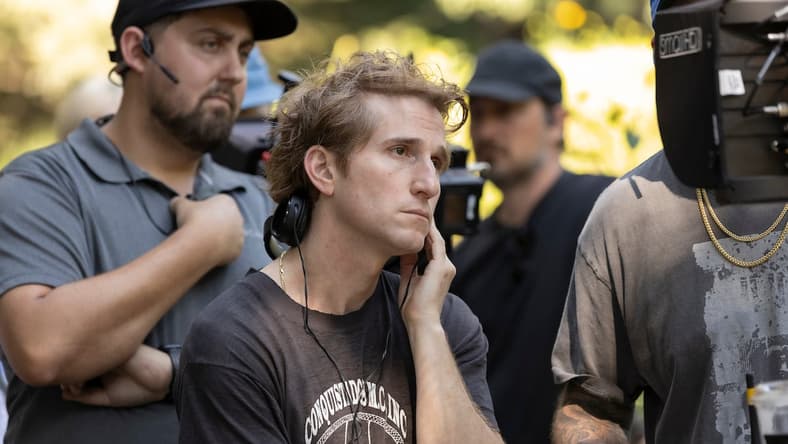
Max Winkler and the rest of the team behind Love Story went back and forth for months on whether the series should open with John F. Kennedy Jr. and Carolyn Bessette on the airfield, before their final flight.
Starting the series with the couple bickering, and then making up, was a way of directly confronting many elements of the Kennedy-Bessette dynamic at once: the sacrifice, the unwanted publicity, the tragedy. But also the real love between two people who overcame countless obstacles to be together. It feels alive and spontaneous, even as it takes us back to an unreachable time.
Winkler had to work hard to capture the scene — it was shot shooting at a Westchester, New York airport with many limits on where the production could go. Winkler, cinematographer Jason McCormick, and the cast and crew had to wait for precisely the right light, and shoot fast once they had it.
“We’d rehearse, rehearse, rehearse, and then we’d get a couple of bites of the apple, and I’m so grateful that we waited and got it at the right time,” Winkler recalls. “I care less about how everything looks — what I care about is the soul of it. But they have that kiss, and there’s this moment, this tiny little string of saliva that connects. It’s one of those beautiful moments, and the sun’s coming in, her hair is perfect, and you really kind of understand the gravity of the series in that moment.”

The string wasn’t planned. But it’s one of many authentic touches that bring the story of two icons down to earth. Through all the logistical and storytelling challenges of the series, Winkler made sure it always felt like “a love story about a guy named John and a girl named Carolyn who are from very different parts of the world. And there’s a lot of people that don’t think they should be together, but they really know that they should be together.”
The scene starts with the couple sniping over her late arrival: Carolyn has rushed from a manicure, and had to evade crowds of people clawing for a look at her. Her and John’s differences seem insurmountable, until he kneels and apologizes.
“She’s looking for cigarettes, and he kisses her. And I just felt like, I think this is the show,” Winkler says. “I want people to be rooting for these people, and by that point we had filmed for a couple of months, so they had a real rapport with each other, a real chemistry, and I just felt like, when I saw that moment… I know this is gonna work.”
Winkler is the son of Henry Winkler, but he laughs off the notion that he felt any special rapport with JFK Jr. because they both had famous fathers. He says Kennedy is relatable on the show because of the writing and research of Love Story creator Connor Hines, and the dynamic between stars Paul Anthony Kelly, who plays Kennedy, and Sarah Pidgeon, who plays Bessette.
Pay Winkler a compliment, and he’s likely to redistribute it to the cast, the crew, or even the setting of Love Story. He notes that audiences are innately interested in the New York City of the ’90s, the Kennedy legacy, and Bessette’s work for Calvin Klein.
But as the director of the first episode of the nine-part FX hit, Winkler played a key part in bringing Love Story to life, and making it a cultural phenomenon. He works with the show’s executive producer, Ryan Murphy often, and Murphy reached out to Winkler about Love Story while he was in post on another of their collaborations, Netflix’s Monster: The Ed Gein Story.
We talked with Winkler, who is also an executive producer on Love Story, about his early memories of the ‘90s, silent takes, and shooting in God’s Time.
Max Winkler on Shooting the Pilot for Love Story

MovieMaker: I was in Central Park a couple weeks ago, and saw a guy jogging by who was almost doing JFK Jr. cosplay — shirtless, backwards hat, sunglasses. And of course there’s been a new appreciation of Carolyn Bessette’s fashion. Were you blown away by how your vision has spilled over and become everyone’s vision?
Max Winkler: I was always aware of John F. Kennedy Jr. and Carolyn Bessette’s inherent style, and just how incredible they were with putting clothes together, and how beautiful they looked, and stuff like that.
You know, the Indian restaurant we shot at, Panna, now has lines down the block. I’d never done something that had such an immediate effect. … I was filming in Italy when the show came out, and I would wake up and my phone just had many, many, many emails on it every single Thursday or Friday morning. Because it was on FX, it would be a weekly thing — you get to ride it so much longer, because people kept going back from the start, finding it later.
MovieMaker: These characters are so iconic. How do you sort of bring them down to earth and find their humanity and make us care so much about them?
Max Winkler: Just the casting — we cast two inherently good people, and they feel that way. They were both warm, and they’re kind, and they were really respectful of each other. And then our mission was to strip away the headbands and the vests and the bikes and the bike shorts in Central Park. You strip away the Kennedys and you strip away Calvin Klein of it all and you still want to watch these people fall in love, and you still want to root for them.
I felt like if we could get the casting right, we had a real chance, because I thought the writing was so good. And horror and love stories are the two kinds of genres that will always have an audience, because for horror, people want to feel exhilarated, want to work through their stuff or have a cathartic experience, whatever that is. I don’t really like to watch horror movies, but I always wanted to make a classic love story, a really romantic movie. I was obsessed with Sydney Pollack’s Out of Africa.
MovieMaker: Do you have any memories of JFK Jr. and Carolyn Bessette from your own life? You must have been about 10 when they met.
Max Winkler: Yeah, totally. I remember that weekend when they went missing. I remember pictures, more of JFK Jr. than Carolyn, and I knew a lot more of him.
I think one of the reasons why this show was so successful was because it was really similar to how The Crown [portrayed] Princess Diana. We know the idea of these people, but there was such an inner life to her, and so much that we didn’t know.
It was really the fashion people that gave [Carolyn] a rebirth before our show. She’s a spiritual figure to almost everybody who has an interest or career in fashion, because of the simplicity and how effortlessly she seemed to put everything together.

MovieMaker: The apparent effortlessness is crucial — Carolyn is never promoting herself to JFK Jr., or to the audience – she doesn’t seem to care about people’s approval, and the show is kind of the same way. It isn’t one of these grabby, “you must pay attention to me” type of shows. It just really sort of seduces you. It’s cool.
Max Winkler: I think 1992, 1993 New York City does a lot of the heavy lifting, you know? Living in Tribeca in that period of time, music, the clothes. Being inside Calvin Klein’s office, and seeing them put together those campaigns, and discovering Kate Moss, it changed fashion. I always felt like if we believed in their love, and we believed in that first meeting, and we’ve done the heavy lifting in the performances and the casting and the design of our plan, by the time they first meet at that benefit, we won’t need to do anything super flashy.
MovieMaker: Were you worried about offending people? Almost anything that happens could offend someone — even starting the series right before they die could upset people. Did you have to just put that out of your mind?
Max Winkler: We did a tremendous amount of research, and we tried to just tell the stories as truthfully as possible, and to do their love story justice. Every decision I made when directing that pilot was based on, “What will do this love story between the two of them justice? … How would we make this feel lived in and real, and not like some fan fiction performance? How do we really get into the souls of these people, and let people in?”
I really just felt like our approach was respectful and not salacious, not looking for shock or awe. At a certain point it really became about getting the best performances out of the actors possible, capturing that moment in New York City that was so alive.
MovieMaker: Were you surprised by the Daryl Hannah New York Times piece?
Max Winkler: I think it sucks to see yourself be portrayed in any way that’s different from your experience of it, and I thought I thought, based on what I knew, that we had done a really respectful job of portraying Daryl. And I thought Dree Hemingway did a really wonderful job playing her and giving her, you know, a lot of nuance and a lot of layers. … Daryl has every right to express herself, of course, but I always found Dree’s portrayal of her kind of very human and imperfect. And, you know, it’s not a bible for what actually happened. Dree is playing the character of Daryl Hannah, and it sucks that Daryl felt that way, and she’s every right to express herself of course.
MovieMaker: I still found her likable. Not every relationship works out.
Max Winkler: Me too. And [Kennedy] wasn’t his best self with her as a partner. He was trying to control her, and he wasn’t accepting of who she was. I don’t think either of them come off as their best self in that relationship, while they were together. But you know, for the pilot, Darryl was only in one scene, and I thought Dree Hemingway did a really terrific job.
MovieMaker: You mentioned Out of Africa. What were some of your other reference points?
Max Winkler: When I first read it, Ryan and I talked about their first meeting, and one of my favorite movies of all time — the original West Side Story. The moment when Tony and Maria see each other, and there’s a slight color shift.
Baz Lurman’s Romeo + Juliet, where they keep missing each other, was something else I was obsessed with. I knew I wanted them to keep missing each other when they walked in.
Ryan was obsessed with this idea that they were separated by a paparazzi the first time they see each other, so that was a really important moment for him, and I love their looks towards each other. She goes in the back door, he’s on the red carpet, and time slows down.
Jason McCormick taught me this thing called God’s Time. If you shoot things at 33 frames per second, it’s just slightly bit off, and I learned it when the first time we worked together.
We looked at a lot of street photography from the time… and a lot of Gordon Willis’ work that he shot in New York was important to us.
We wanted it to feel totally uncomposed… I wanted it to just be like these two incredible people are walking away from us, but the camera just fell off the truck, and we only had a chance to get that image really quickly. Trying to take away any preciousness from the filmmaking was super important to us, that’s why we looked at a lot of street photography with New York in that time period. A lot of it was trying to unlearn the kind of cute tricks and stuff that I’d become obsessed with, and just have it be super natural.
Also, Jason happened to be a genius handheld camera operator. Carolyn waking up in the morning, and being with her as her eyes open and her feet hit the floor, and she brushes her teeth, and she’s walking on the street — that’s Jason holding the camera, and there’s an energy we never would have had if he hadn’t done it handheld.
MovieMaker: The filmmaking seems like it really reflects Carolyn Bessette’s aesthetic, in that sort of casual beauty.
Max Winkler: There was no showing off in any of the filmmaking, nothing like, Wouldn’t it be cool if we did this? It was all about their faces, portraits, their eyes, their looks. I wanted to be a show about looks. Anytime we could get those moments, quiet moments — just seeing her walk into the Calvin Klein office for the first time and blow out her cigarette, seeing him look at her across the paparazzi for that first time — those things. My favorite moment of the show is their connection at the very end at the Indian restaurant.
Something I learned from David Gordon Green, who produced a movie for me, was anytime you have time, do a take where they just do the whole scene silently. No one says a word. Just do it. And I did that a bunch — again, with genius handheld operating by Jason.
When she was measuring him for the suit, a lot of that scene is moments that we shot at 33 frames, and neither of them said anything. It’s just blocking and they’re acting the scene with their faces. I’m not really like a theater school kind of guy, but for those two, when you’re building chemistry out of nothing, it really helped, especially because you know Sarah’s got a tremendous amount of experience. Paul had way less experience. It was a great way to get him warmed up and get into the vibe of it. He worked with this incredible acting teacher named Nancy Banks. … Those silent takes really got him warmed up.
MovieMaker: That scene is incredible. So much of early relationships is finding pretexts to spend time together, and her measuring him for a suit is such a great reason for them to be physically close and intimate. Beautiful scene.
Max Winkler: The writing had that, and then that’s so much about Sarah’s understanding of Carolyn. She worked with a great movement coach, and she really studied everything she could find about Carolyn. There’s no way to mimic Carolyn — there’s not enough material to do it — but to get her essence, she owned every space she was in, the way she would sit, the way she would move.
When she puts the pen in her mouth and then puts the pen behind her ear, she takes the notes, she’s got the tape on her — that’s Sarah Pidgeon. And the ability to shoot that handheld gives Sarah Pidgeon total freedom to own the space, and we just follow her. … I knew that she knew what she was doing better than anybody, and in that moment, our job was just to catch up with her and not get in the way, and just let her own the space. And Paul’s job is to just be enamored and completely in love with her, which is very easy to do with Sarah, because she’s so likable.
Love Story is now streaming on Hulu.
Main image: Max Winkler on the set of Love Story. Photo by Eric Liebowitz/FX