
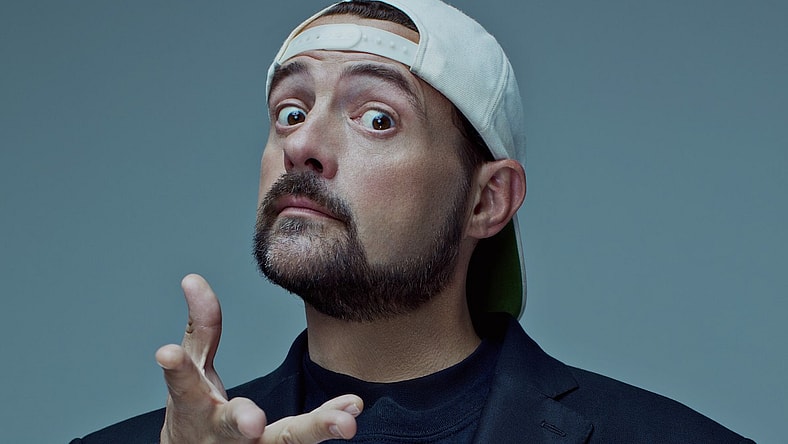
Kevin Smith likes to joke that his Q&A sessions include a little bit of Q and a lot of A. That was very true when we talked with him at the El Paso Film Festival.
Smith’s films include the ’90s comedies Clerks, Mall Rats, Chasing Amy and Dogma, the 2014 horror film Tusk, two Clerks sequels and three films about Clerks characters Jay and Silent Bob, the latter of whom is played by Smith. He also executive produced and starred in the reality show Comic Book Men, based on life at his comic book store, Jay and Silent Bob’s Secret Stash, in Red Bank, New Jersey.
This year, he plans to make his 17th and 18th films — one that he describes as “the next fucking Jay and Silent Bob movie, that nobody asked for,” and the other the long-planned Moose Jaws, which is kind of like Jaws, but with a moose.
When we asked him what kind of big-picture advice he wished he’d heard as a young filmmaker, he delivered the following monologue, which we are sharing mostly uninterrupted.—M.M.
Kevin Smith on His ‘Hustle,’ as Told to MovieMaker

It’s something I’ve been thinking about a lot lately, ever since I got out of the nut house. A couple years ago, I went into the Sierra Tucson treatment center. I had a breakdown, spent a month in there, and came out whole. I’d lost my marbles.
When I started, I wanted to be a filmmaker. I wanted to be a director. And so I made Clerks. And after that, they were like, “You’re a filmmaker.” They told me I was the thing that I wanted to be, which is heaven on earth — other people acknowledging you as you see yourself. And so I went from being a convenience store employee to a filmmaker.
And I was a filmmaker for a while, maybe about 10 years, but then a side hustle started to develop: When you go to film festivals, when the movie’s over, they push you out on stage to explain yourself. And so I would go out and do Q&As. And since the first film I made looked like it was shot through a glass of milk, I didn’t feel like I could pretend to cinematic erudition that wasn’t mine. I didn’t want to go on a stage and talk about my theories of filmmaking. I didn’t really have any. I’d made one movie.
So instead of going up there and trying to sound intelligent, I would get up and be like, “Let me tell you guys how we got that cat to shit on cue.” Just funny stories about how the movie was made. And because of that, this side hustle emerged where I became known with the movies.
My generation of filmmakers — I think this has everything to do with Miramax — you knew our names more, and now you know directors’ names more thanks to the internet. There was a whole period of time where people knew Spielberg and George Lucas and Scorsese, and that’s where the list ended.
But in the ’90s, you started hearing about like Quentin and Robert Rodriguez and me and Eddie Burns and stuff. And that’s because of the simple brilliance of putting a filmmaker out there to promote their film. None of these movies had famous people in them. So you couldn’t be like, “Get Angelina Jolie to go on The Tonight Show.”
To get any sort of press interest, they would say, “This is the guy who went into medical testing so he could get seven grand to make a movie!” or “This is the guy who shot a film all around his hometown, where Austin is the main character!” or “This is the kid who made a movie in a convenience store!”
Those back stories would make people go, “Huh?” And then you’d put the filmmaker out there to speak, and even if they weren’t charismatic, hearing about their passion for the stories they were trying to tell, and how long it took to get there — the uphill battles and the little victories — could be inspiring and entertaining.
And so because of that, we wound up, us Miramax kids, out in front of the movies more than the cast. Later on, we’d get famous people to work with us, and they also would go out there. But by that point, we had already become kind of known entities.
I grew up watching standup comedy my whole life. I’d never intended to be one, but I kind of had a back door into it, by virtue of the fact that people had to listen to me. So I could be funny and stuff. I developed this whole side hustle as me, Kevin Smith. And at a certain point, I thought I was so smart — I became me for a living.
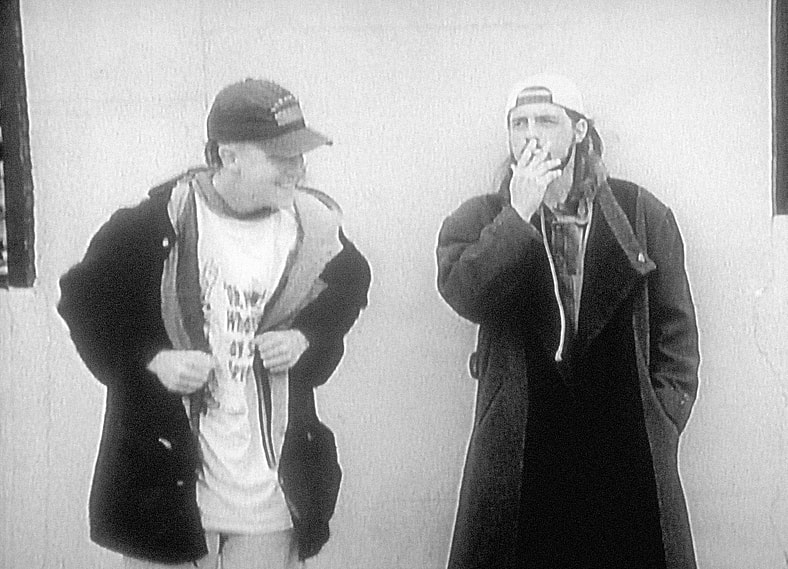
So I went from being a director to being Kevin Smith for a living. And directing is just one of the things that Kevin Smith does — he writes comics, does podcasts, does this, does Comic Book Men. He’s on stages talking and shit. So I became me for a job, and I think that’s why I wound up in the nut house.
Because when you’re you for a living, you’re working from the moment you wake up — and you’re on the job until your head hits the fucking pillow. You want to talk about burning the candle at both ends? That’s like burning a candle with no wick whatsoever. It’s just all wax, and eventually it crumbled. I got away with it for about 15 years, and then: Snap.
It has to do with the crushing fucking need for neverending relevancy. When you are yourself for a job, your fortunes depend on people giving a fuck about you, and we know we live in a world where most people don’t give a fuck about anybody else.
I don’t think it would have changed anything one iota, but if I could go back in time, I would tell the kid who’s making Clerks, “Everything’s gonna come true, all your fucking weirdest, wildest dreams. Shit’s gonna happen. But the price is, every day of your life, you’re gonna have to figure out a reason why people should give a fuck about you. You will chase relevancy until you fucking die.”
It’s like the chimp with his hand through the hole, holding onto the banana. You let go of the banana and you’re fucking free.
I can’t let go of the banana, so I’m fucking trapped for the rest of my life trying to make you care about me, trying to make strangers I’ll never meet be invested in my life and my misadventures and my fucking artistry, so that I can continue to pay my bills for one more day and not go back to the convenience store. Because of that, I think I wound up having the fucking breakdown.
And they couldn’t cure me when I was in there, and they were very upfront about that. They were like, “Look, we’re just gonna give you a bunch of tools, because you’re gonna fall in the hole for the rest of your life. It’s impossible not to. The hole is always there, and even if you know where it is, you will fall in. But what we’re gonna teach you here will help you get out of it faster, so you’re not trapped in the darkness.” So it was absolutely useful.
We’re on the go even more now as a society, or civilization, than we were as ’70s and ’80s kids. It is nonstop, like constant, and nobody takes the time to reflect. Nobody can appreciate the moment they’re in, because they’re so busy trying to get to the next moment. Because that’s where success lies. It’s not here, it’s right up there. It’s just around the fucking corner. Even for people who have fucking succeeded, nobody lives in this moment. We relitigate the past, and we spend all of our time in the future worrying about what might happen and stuff.
So because of that, man, I spun out. Now I know what it is. Now I know who I am. I’m a codependent people pleaser who cannot validate himself — and shit like that.
I will fall in the hole again. It’s inevitable, but I’ll know what it is this time. And last time, I had no fucking idea, and that was terrifying, because I was literally going crazy.
Who knows? If I didn’t have art, maybe I would have gone crazy in a different way: living outside of a thing and wanting to do it, wanting to be involved, wanting to be seen as the thing you say you are.
I only lived for 23 years as a normal-ass, real human being, before Clerks happened, 31 years ago. So I’ve been a creature of the industry and a creature of entertainment for longer than I was an actual human being: thirty-one years versus twenty-fucking-three. It’s the only thing I know how to do at this point. I couldn’t be a real human being if I ever wanted to.
So I cannot simply let it go and go live a life that’s based in the here and now. That’s what I kept telling them in the nut house.
“They’re like, ‘You’ve got to stay out of the future, Kevin.’” I was like, “My whole fucking job is about the future. It’s about, ‘OK, when we make this story that doesn’t exist yet…’” So how the fuck am I supposed to stay out of the fucking future, man, where all this peril is?
So it’s a fraught walk, man, and I’m sure if I’d never been a filmmaker, I wouldn’t have these issues. I would have different issues.
But oftentimes I wonder: If I’d just kept working at the Quick Stop, would I ever have wound up at the nut house?