
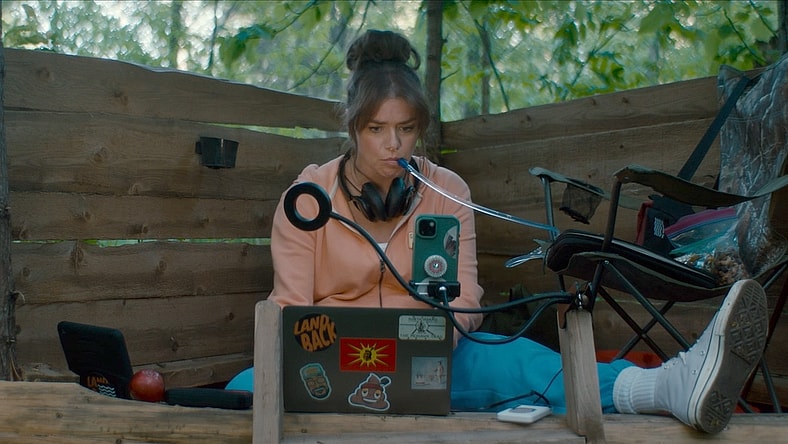
Kaniehtiio Horn is an actor-writer-director known for Reservation Dogs, The Lowdown, Mohawk, and more. In the piece below, she details the making of her feature film directorial debut, Seeds, which is in theaters today from Indican Pictures.
I’ve seen a lot of Indigenous filmmakers explore healing through their work, but I find myself exploring rage. I’m from Kahnawake, near Montreal, where my people, the Kanienkehaka, have fought colonialism for 500 years. During a well-known stand-off in 1990, my family was protesting plans to expand a golf course onto Native land when my sister, then 14, was bayoneted in the chest by a Canadian soldier, while protecting me. I was four.
As a mixed race, white-passing Kanienkehaka woman, I never believed I would be cast to play an Indigenous person. Growing up, I was disillusioned: I never saw any Indigenous people on screen who didn’t have two braids and a heavy broken accent, either drunk or mystical. Here I was, blue-eyed and light-skinned, so I figured I better focus on being the best performer possible and building a diverse resume.
I knew I wanted to make my own things eventually. I had dabbled in filmmaking when I made my 2012 short “The Smoke Shack,” with Big Soul Productions, about my time working in a cigarette store on Kahnawake. Then I auditioned for the late Jeff Barnaby’s short film called “The Colony,” which was looking for a dark-skinned, curvy Native woman.
I went in extremely prepared, and knocked the scene out of the park. He cast me, and being young and insecure about my identity, I asked if he wanted me to darken my red hair — “you know, to ‘look more native.’”
He said, “If anything, dye it even more red. You’re a fuckin’ Indian and that’s it.”
That was my first taste of a Native person being at the helm of a project and making the decisions. Real recognizing real. Fuck yeah. It also lit a fire in me to make my own projects.
I remember the day things changed. I was smoking a cigarette with some crew while filming Ted Geoghegan’s 2017 film Mohawk. It was a particularly grueling shoot all over the woods in upper New York state. I thought, I just want to make a film with friends in one location, do some stunts and practical FX, kill people, and have some damn fun. Inspired by Home Alone, Shaun of the Dead and the Canadian classic Clearcut, I wanted to make the kind of fun ride I saw as a teenager, for this generation. I craved seeing a smart, relatable, kick-ass Indigenous female lead who I could cheer on, and a soundtrack I could rock out to.
Kaniehtiio Horn on the Bringing Seeds to the Screen

The pandemic gave me time to think, and put my thoughts into a script that became Seeds. I developed the story and found the tone, then showed it to executives, taking in their feedback.
A producer, Leonard Farlinger, liked the idea of a story about a Native woman returning to her roots and finding out that the company she works for is taking advantage of her people, again. We took an early draft to the Frontieres film market in Montreal, as part of the Fantasia Film Festival, and met with executives, financiers and producers who weighed in on the script. We worked on it and took it to Canada’s Indigenous Screen Office, which became our first investor. The fact that I was Native was a positive in a time when the world was finally recognizing who we are as a culture.
I drew on some of my own lived experiences of leaving and returning to the rez, and the idea of figuring out what it means to be an Indigenous person in this day and age, but remaining tied to our past and to the land we were put here to care for.
I wanted to make an Indigenous film that relates to everyone. Having the antagonist go after money seemed like a cliché to me, and I wanted something that was precious to my people in particular. That’s how I landed on the Three Sisters — corn, beans, and squash. They are seeds, or sustenance. The company in the film tries to control these seeds, and the metaphor just made sense. I never intended to write an anti-colonial, genre-bending, food sustainability film. I just followed my creative instincts and where they led me organically.
My character, Ziggy, carries strength inside of her, and rage passed down from centuries of intergenerational trauma due to colonialism. My advice to other filmmakers in the independent world is to channel your rage, find your voice, bring your perspective to your project and don’t shy away from being who you are: Trans, Native, Black, Asian, Hispanic, Mexican, White, whatever. All of you have a voice that needs to be heard. Make it so. But it’s okay to laugh.
Some of it is luck. Around the time I was developing this film, I booked the role of the Deer Lady in Reservation Dogs, which felt serendipitous. She is a being who was hurt but now has a mission, and I felt a deep connection to her. I have realized over my lifetime that a lot of rage exists inside me: Being a woman, and on top of that, Indigenous, there are a lot of things on the daily that just piss me off. I used to inflict my anger on myself by abusing drugs and alcohol, but now I have this medium to explore it in a healthy way. To become myself.

In addition to Leonard, I found another lovely, eccentric producer, Jenn Jonas, who allowed me to explore, who encouraged me to get/be weird. I didn’t want to direct the film, but the producers, along with my friend Jacob Tierney, assured me that my voice mattered, and that I could do it. So we made this crazy film with practical FX, stunts and, I hope, comedy. Seeds mixes humor with a dark and grounded visual style, and I wanted to let the audience know that they are allowed to laugh from the get-go.
Leonard helped me get more financiers on board, including Telefilm, Ontario Creates and the Northern Ontario Heritage Fund. Without them we never would have been able to make this film. Some of this government money was in the form of grants we didn’t have to pay back, which limited our need for private equity.
Also Read: With ‘kamikaze,’ Ray Smiling Makes Sure Nobody’s Bored
Additionally, we are fortunate that the Canadian film industry protects us, making sure we have a home on TV. We were able to secure a Canadian distributor, Level. They helped us secure a linear cable and VOD life in Canada for some money right away.
Directing yourself in a feature is strange and arduous, but I had many people looking out for me, including my cinematographer, Jonathan Cliff, who realized my vision beyond what I hoped for. After production came editing, with Lindsay Allikas, a woman who seemed to just get it. She picked up what I was trying to put down and amplified my voice while perfecting the structure of the film.
We were fortunate enough to raise enough money to make this a union film, but we shot quickly and efficiently in 18 days. That allowed everyone to make a good wage, but for the film to still be reasonably priced.
My advice to anyone making a film is to look for and find any advantage, be open to collaboration, and have faith in yourself. Find your voice, trust your instincts, and be creative in financing — but never give up your voice.
Seeds arrives in theaters August 22 from Indican Pictures.
Main image: Seeds writer, director and star Kaniehtiio Horn in Seeds. Courtesy of Indican Pictures.