
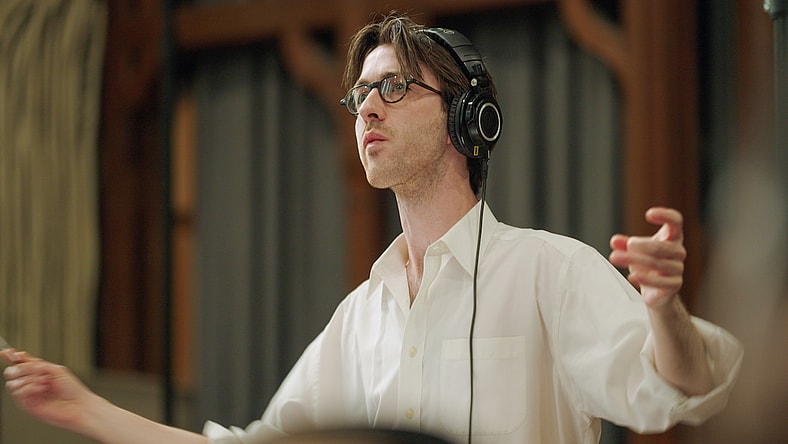
“Bumblebees tend to go around in middle C, specifically because it’s the resonant frequency of tomato flowers, which is generally what they go for,” explains Bugonia composer Jerskin Fendrix. “They have this thing called buzz pollination, where they’re too fat to get inside the flower, so they have to have a pretty set frequency to cause the flowers to basically shake off their dust.”
Fendrix knows the musical key of bumblebees not just because because Bugonia opens with his Oscar-nominated score intermingling with the sound of bees, but because he is an inveterate reader and researcher.
Born to academics, he is so fond of research — including about ancient Greek theories on nature — that he knew what the esoteric title of Bugonia meant without anyone having to tell him.
Let’s save you a Google: The word “bugonia” refers to the ancient Greek belief that bees could be born from the rotten carcass of a sacrificed animal — a symbol of life coming from death. The reason Fendrix knew the phrase was because he had read a book about bees years before Bugonia director Yorgos Lanthimos enlisted him to do the score for the film.
“There are so many ancient Greek ideas which make sense in a kind of child’s-logic way. There are insects that come from livestock carcasses — like maggots,” Fendrix notes. So the idea of bees also being born in rotting flesh is “not the stupidest idea in the world.”
Fendrix was born Joscelin Dent-Pooley and raised in the West Midlands of England. His mother worked in psychology — particularly clinical psychology and child psychology — and his father worked on English literature and theology. They were also “enthusiastic amateur musicians,” Fendirix explains, and they got a hint of his musical prowess when he climbed onstage at a wedding in the late ’90s and started “messing with the drum kit.” He was about two.
In the ensuing years he pursued violin, piano, and other instruments, and eventually began releasing music under the name Jerskin Fendrix, based on a friend’s joking mutation of his actual name.
When Lanthimos came across Fendrix’s emotional, avant-garde 2020 debut album Winterreise, he asked one of his producers to contact Fendrix. The musician went on to compose the music for Lanthimos’ 2023 Poor Things, 2024 Kinds of Kindness, and 2025 Bugonia. He earned his first Oscar nomination for Poor Things and second for Bugonia.
While many composers read a film’s script or watch footage before they start to compose, Lanthimos gave Fendrix just three words of inspiration: bees, basement, and spaceship. Fendix also knew the name of the movie, and, of course, it’s meaning.
He went to work — reading and researching to build ideas, and then turning them into music.
“Yorgos likes all the music before filming starts, so he can use it on set, just to kind of give an atmosphere and maybe a sense of the pacing of a certain scene,” Fendrix explains.
Freed from almost any limits, he created a score that ranges from atmospheric to anthemic to explosive. Which was exactly what Lanthimos wanted.
Initially, Bugonia seems like a hostage drama between a tech executive, played by Emma Stone, and two conspiracy-minded kidnappers, played by Jesse Plemons and Aidan Delbis. But the film turns out to be about much more.
For long stretches of the first half, Fendrix’s score provides the only foreshadowing that we’re not watching a small, basement-set crime story, but rather an epic.
“That’s all down to his very peculiar, but very well-thought out directorial decision,” says Fendrix.
Jerskin Fendrix on Collaborating With Yorgos Lanthimos on Bugonia
Fendrix says Lanthimos never nitpicks his work.
“There are never specifically notes on like, ‘Oh, can you change this instrument to that? Or can it be a bit faster or happier or whatever?’ It’s always just yes or no,” Fendrix explains.
Very occasionally, a piece of music must be cut to match a certain scene, or because it doesn’t intermingle well with the dialogue — “at which point we do a lot of butchering,” Fendrix deadpans.
Though Lanthimos avoids prescriptive direction, he did gently push Fendrix to go big, by asking that he work with a 90-piece orchestra.
“He knows my ego well enough to know that I wasn’t going to use it tastefully,” Fendrix adds. “I was going to go as loud and intense as possible. And as a result, in the film, the score doesn’t sound like three people talking in a basement. It sounds like a guy fighting for the fate of the Earth.”
About those bees buzzing through his score: How did Fendrix make sure the music was in tune with the bees, if he couldn’t see the film beforehand?
“I’m giving full credit here to Johnnie Burn and his team,” says Fendrix. “Johnnie Burn, the head of sound design for the film, is a truly unique and talented, unusual sound designer who won the Oscar a couple of years ago for The Zone of Interest, which has some of the most horrifying sound design one can imagine. And he works extremely hard, and we worked together on lots of parts of the film to make sure that the sound design and the dialogue and the music are able to have their own moments when they need them, and they can work in harmony.
“There are thousands of recorded bee sounds for the opening sequence, and Johnnie Burn individually tuned every bee sound so it would be perpetually in harmony with the strings and the score. He spent a long time doing that, so that’s completely down to him. And I think the effect is incredible.”
Bugonia is now streaming.
Main image: Composer Jerskin Fendrix during the scoring session of director Yorgos Lanthimos’ Bugonia, a Focus Features release. Photo Courtesy of Focus Features © 2025 All Rights Reserved.