
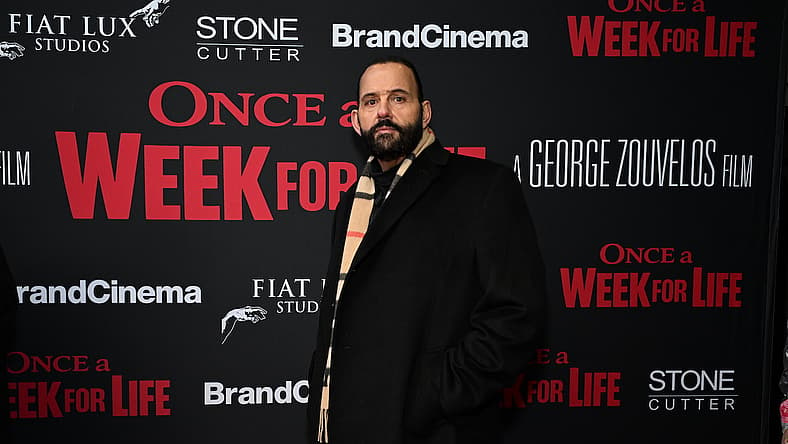
In an era dominated by franchise logic and algorithm-friendly storytelling, filmmaker Once a Week for Life writer, director and star George Zouvelos isn’t interested in franchise logic or algorithm-friendly storytelling — his process is stubornly rooted in lived experience, moral ambiguity, and the contradictions of real people.
Once a Week for Life, is a New York crime drama that nods to its influences while carving out a voice of its own. The cast includes The Sopranos alums Robert Funaro, Al Sapienza, and John Fiore, as well as Armen Garo (The Departed, The Wolf of Wall Street) and John Kapelos (The Shape of Water).
Zouvelos stars as volatile NYPD lieutenant and Navy SEAL veteran Adam Glanis, who battles PTSD and addiction while leading a fugitive task force. When a botched sting resulting in the death of his partner ignites a dangerous chain reaction involving a mob crime family and City Hall power players who want him dead, Adam faces an impossible choice: die, or survive by becoming something worse.
Zouvelos calls the character “a moral masochist” — “a guy who has to either atone through ruin or live by his own code.”
Once a Week for Life Is a Story Told Through Personal Damage

Zouvelos — an-award-winning actor, writer, and director, and filmmaker, employs a deliberate visual strategy. Desaturated tones dominate Adam’s drug-addled point of view, while scenes outside his consciousness appear sharper, more vivid.
“It’s not a mistake—it’s a creative decision,” says Zouvelos. “Adam is telling the story backwards, and he’s high, he’s drunk. When you’re in his head, things aren’t vivid. Outside of him, the world sharpens.”
The film’s title reflects the rhythmic nature of the dangers, betrayals, and ethical choices Adam faces in his line of duty.
That subjectivity extends to the narrative. Zouvelos avoids telling audiences what to think, instead offering fragments of perspective.
“I don’t make declaratory statements,” he explains. “I want the audience to decide who they trust. I’m not spoon-feeding anything. I’m breadcrumbing.”
Zouvelos takes a restrained approach in which violence and sex are implied rather than shown, and the emphasis is on aftermath: addiction, guilt, destroyed marriages and the erosion of a life out of balance.
“There’s no need for gratuitous violence or arbitrary sex,” he says. “The story is about what’s happening in their heads.”
Adam, perpetually intoxicated and haunted, becomes less an action hero than a cautionary figure. “He doesn’t even get the satisfaction at the end,” Zouvelos notes. “That’s life sometimes.”
George Zouvelos on Coffee Cans and Creative Control
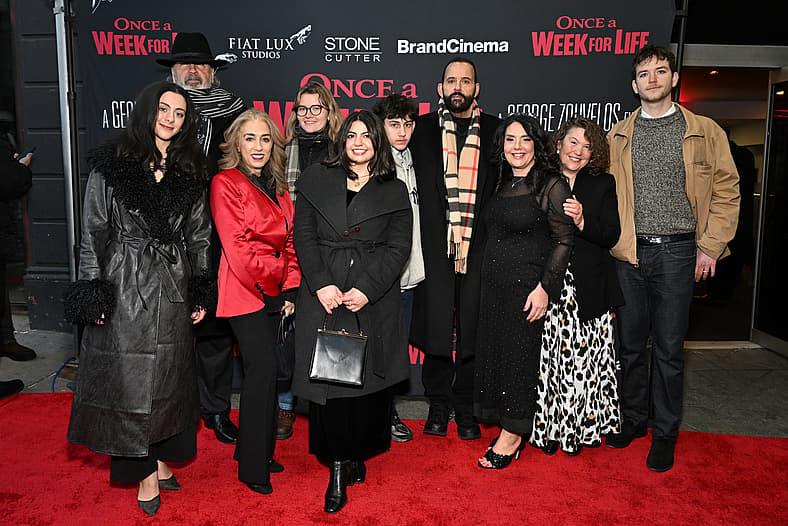
The origins of Once a Week for Life are as authentic as its sensibility. Zouvelos, who grew up in Astoria, Queens, and has worked as an EMS and with the Brooklyn District Attorney’s office, draws heavily from real-life encounters across New York.
He spent years jotting thoughts and experiences onto scraps of paper, storing them in coffee cans – distilling an archive of memory and experience he still mines.
“There’s a lot of pain in there,” he admits. “That’s where the work comes from.”
Authenticity is the film’s backbone.
“I write about things I know—real people, real suffering, real humor,” Zouvelos says.
That approach extends to the cast. Some performers draw directly from their own backgrounds, including a retired NYPD detective who appeared in the film and insisted on keeping her unfiltered delivery intact.
‘Actors Are Diamonds’

Zouvelos’ directing philosophy is simple: create space for character, not performance. “Actors are diamonds,” he says. “They don’t shine—they reflect.”
He often lets scenes roll before and after “action” and “cut,” capturing something less rehearsed and more organic. “I don’t want acting,” he adds. “I want behavior.”
The approach resonated with his cast, including Kapelos, who was struck by the film’s dark comedic tone.
“It was much funnier — much more humorous and much hipper than I was expecting,” Kapelos says. “There was a texture to the movie… a Sidney Lumet-type quality.”
Common Ground
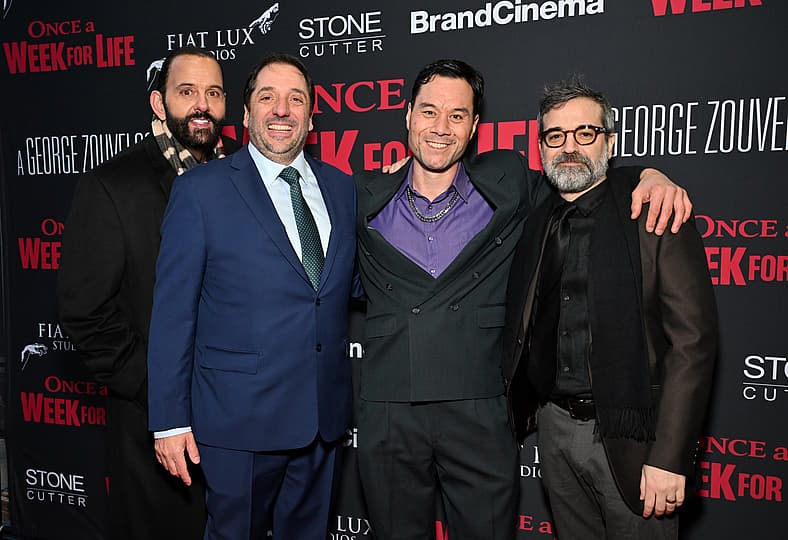
Though steeped in crime, the film carries an undercurrent of social commentary, one Zouvelos is careful not to turn into preaching.
“The film says something about where we are without saying it outright,” he explains. “We focus too much on differences. Left, right — it doesn’t matter. We’re all people.”
Zouvelos says the film was influenced by the political climate in New York.
“The city is constantly shifting with the current polarizing from the left and right. Extremes are dangerous,” he says.
“I am somebody who likes to play both sides, because I don’t agree with either. We are people. There’s blood running out through our veins – we should celebrate our commonalities and stop focusing on our differences.”
He added, “And that’s what New Yorkers do. Whether you’re left or right, whether you like Trump or hate Trump, love or hate the mayor…It’s irrelevant. What’s relevant is, let’s focus on our commonalities.”
Zouvelos is more skeptical of performers as political arbiters, arguing for storytelling that reflects human complexity rather than prescribing ideology.
“Actors are not supposed to be giving political or social commentary. Actors are supposed to be entertaining people, and that’s what we forget,” he explains.
“For some people who reach a certain status in Hollywood, it feels that it’s their moral obligation to tell the rest of us how to feel. Yeah, some of it is virtue signaling.
“The audience should be entitled to feel any which way they want without being vilified.”
Advice for a Fellow New Yorker

Which brings us to Timothée Chalamet. Zouvelos sees the dustup over the New York City-born actor’s recent comments about opera and ballet in the context of his own belief that we should all embrace imperfection, own our mistakes, and keep moving forward.
“If I were his publicist?” Zouvelos says. “I’d put him in tights and a tutu, have him take ballet lessons, make him dance down Fifth Avenue.
“Have him appear with the New York City Ballet, fall on his butt and show how difficult that art form is.
“Timothée should be humble. Do a satire about himself and turn it into something real.”
He continued, “If I had flubbed like that, right away you’d see my body look like a sausage in tights.”
It’s all about honesty, Zouvelos says.
“You fall, you get up,” he adds. “You keep going. Because the cemetery is filled with unfinished business.”
Once A Week For Life, produced by Fiat Lux Film Studios NYC and Nicholas Levis, is now in select theaters and available on VOD starting April 14.
Main image: George Zouvelos at the Once a Week for Life premiere at Cinema Village on March 19, 2026 in New York City. Photo by Slaven Vlasic/Getty Images for Jane Owen Public Relations