
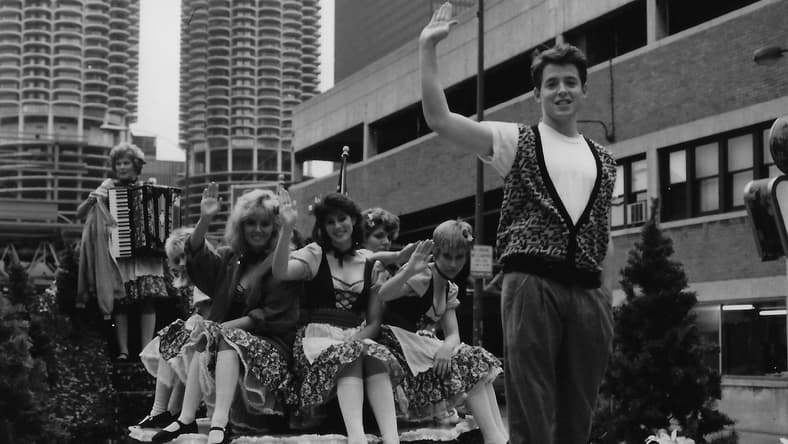
In his new book Ferris Bueller… You’re My Hero, author Jason Klamm goes deep on the John Hughes teen movie masterpiece Ferris Bueller’s Day Off, which turns 40 this June. The film stars Matthew Broderick as the witty, spontaneous Ferris, who decides to give his friend Cameron (Alan Ruck) and girlfriend Sloane (Mia Sara) a day they’ll never forget. One highlight is a parade — which, Klamm recounts, was shot during an actual parade that the filmmakers then recreated a week later to work in scenes with the movie’s stars. The sequence climaxes in Ferris jumping aboard a float to lead thousands of people — including office workers, a marching band, dancing frauleins and many more — in a singalong with The Beatles’ version of “Twist and Shout.” Here’s Klamm explaining how it happened.—M.M.
“I think Matthew got really invigorated by the crowd,” Hughes said. Before the day of the parade, the biggest audience Matthew Broderick had ever had was about 1,500, in a theater.“But this was just hordes of people,” Broderick recalls. “We shot in an actual parade the first weekend, and then they were like, ‘Oh, god, how are we going to get as many people as the parade when we shoot next weekend?’” Hughes solved the problem of recreating the scale of a 200-float parade when he appeared on Fred Winston’s show on WLS.
“They did a promotion with the radio station,” Winston recalls. “They stuck us in Daley Center, and we interviewed a few people. And he was really such a nice man… a real guy, not a Hollywood a——.” They offered up a raffle, so anyone who showed up as an unpaid extra could potentially win anything from a trip to Mexico to some “record albums,” since you weren’t getting paid. This also meant you could leave whenever you wanted, though production hoped that option wouldn’t get exercised.
“I remember John saying the good thing about Chicago was that there’s a parade every day,” remembers Lindsay Doran, who was vice president of production at Paramount. “They had to immediately get to researching to find out what parade they could integrate into without ruining it.”

“Chicago has the most parades of any city in America, or at least it did then,” producer Tom Jacobson says. “Chicago had these immigrant communities that had really maintained their identity. There’s the Polish community, there’s the Ukrainian community, there’s the German-American community.”
Baron Friedrich von Steuben was a general who helped George Washington out during the American Revolution, whipping the colonial army into shape. The Steuben Society, founded in 1919, keeps his legacy alive. So do the Von Steuben Day parades throughout the country, prominently in Philadelphia, New York, and Chicago. It’s often intended as a celebration of German heritage as well, though the likelihood of von Steuben’s homosexuality does leave open the possibility of two very different pride parades a year celebrating him; his monument in DC has since been honored officially by LGBTQ+ veterans for his lasting impact on military training.
On Sept. 21, 1985, Chicago celebrated its 21st Von Steuben Day Parade. The job that day was to integrate the film’s cameras and crew into the parade to shoot it, as unobtrusively as possible, while also integrating their own float into the procession.
There were at least 10 cameras (including a nascent Steadicam), which meant at least 10 camera operators and numerous camera assistants, all of whom reported to cinematographer Tak Fujimoto. Conrad W. Hall was with Fujimoto up on a crane to get the full wide shot of the parade coming down Dearborn Street: “We would come in and get off the crane, and get on a dolly, or get into a situation where we could cover wider versions of the main floats and the ‘Twist and Shout’ routine.”
Key to the parade, on the day but especially on the following Saturday, was the one element that made it look like — and, in some ways just become — an actual parade. Atmosphere. Background artists. Extras.
Second assistant director Ken Collins’ job on Ferris was, among other things, wrangling those extras.
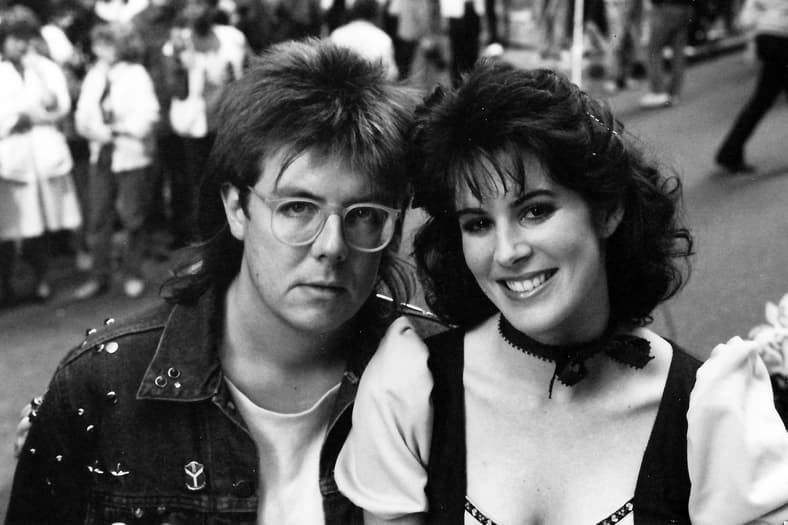
“Extras can be your best friends. They can make you look really good, or, if they don’t like you, or don’t give a s—, they can hide,” Collins says. You can get extras to do a lot for very little pay, but “only if they really respect you, and feel like you’re treating them like human beings.”
Collins’ work goes back to before (and including) Airplane! and in recent years, the TV series Bosch. “As Bosch says, ‘Everyone counts, or nobody counts,’” Collins says. “So many Second ADs that I worked with really just treated extras as the lowest form of humanity on the film set.”
The solution to getting such a disparate group to cooperate is always respect, but it is just as much communication.
“All you have to do is show up in the morning and say, ‘Hey guys, thanks for coming. This is what we’re doing today’… Give them something to actually think about and to motivate them and make them feel like they’re a part of the scene, which they are.”

Media was a smaller landscape in 1985, so it only took a few newspaper ads and the radio appearance by Hughes within days of the parade recreation on September 28 to get a crowd.
“We got about 7,000 people,” unit production manager Bill Coker recalls. Depending on who you ask, they had up to 10,000 extras.
A Surreal Moment on the Set of Ferris Bueller’s Day Off
One of the more surreal moments in Ferris is, like so many other similar parts of the film, subtle and glaring at the same time. It’s also not often that your key into such a moment is hair, but, at a moment of heightened action, Ferris’ hairstyle just changes to something entirely different than it has been the whole time.
“The sort of Fabian hairstyle for Matthew during the parade, we didn’t discuss that,” hair stylist Paul Abascal says, speaking of the 1950s teen singer and heartthrob. The length of the shoot had been getting to Broderick, so he was sweaty, his hairstyle not built for taking that kind of abuse. Abascal quickly found a camera shop with a plug he could use, grabbed Broderick, and plugged in his hairdryer.
“Sat him down on the floor and started drying his hair because he was soaking wet, and then I just pulled it into that pompadour, and then threw him back out there. John loved it.” Considering they had trained on Jailhouse Rock for the dancing, this was the perfect accidental hairstyle for this scene. “If John would have said, ‘What the f— is that?’ I could have just changed it really quickly with some water.”
Hughes knew what some of us take for granted – we’ll often suspend our disbelief even further than normal if the grade toward surreality is quick enough. It goes from a conversation, to Ferris’ voice, to the reveal on the float, and to him lip-syncing to “Danke Schoen.”
The shoot was almost guerilla-style, though they had all the proper permits. “We were literally shooting and then running to get ahead of the parade, and setting up camera and shooting that, and then running again,” script supervisor Pamela Alch recalls of her time at Hughes’ side during the actual parade day.
Tightly run as the set might have been, with thousands of people filling the streets, “We didn’t know all the time which extras were working for us…and which extras were just people on the street,” second assistant director Linnea Wicklund recalls. This was a problem mostly because you could only compel the paid extras to stick around. For some folks, they did what you do with extras – ply them with food.
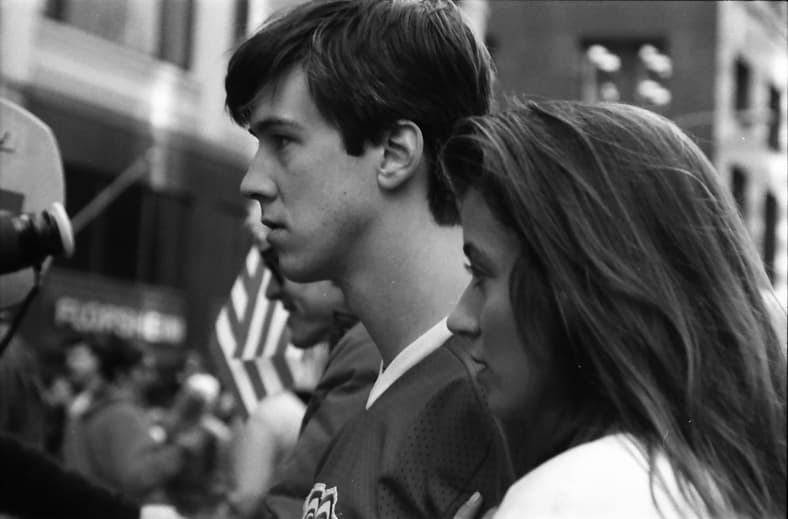
“We handed out hot dogs to people to get them to help,” Wicklund says. They actually had so many extras to feed that someone offered $200 to the first crewmember who could serve 100 plates out of the seven lines of extras that were queueing up to be fed. (They fed them all in 10 minutes).
The night before, Coker had found a basement in a nearby building to stage their extras in before the parade began. Once it did, they all had to stick to their same locations, run into the street every time Ferris came back through, and run back to one when the music stopped. The band was loaded back on to their bus for each loop, with a police escort.
“Up a one-way street, the wrong way, back to the parade route beginning, and reinserted our four units into the parade for a take two. Now everybody all around our extras – the real people who saw what we did on the first take… on take two, when the music hit, and all our extras got out in the street, so did everybody else. That’s how we got that shot on a street that looks like there’s 3,000 people in the street, because there were.”
The South Shore Drill Team has been teaching the youth of Chicago color guard skills like flag and rifle twirling and other performing arts skills to keep them off the streets since 1980. Comedian and filmmaker Maurice Mo’ Jones was part of the team until he was 21 (the dictated age-out year for the group), but saw them quickly go from the first all-Black color guard group to being one point away from the championship. Someone on the Ferris production team saw the group performing and invited them to the 2nd Unit shoot for the parade sequence.

“We were throwing a rifle in the air. We would do front rolls and come back and catch them,” Jones tells me. “They had us do our routine on the concrete, four or five times to get the right angles. They never used any of that.”
They worked closely with choreographer Kenny Ortega the whole time, and what the film did use became one of the most memorable shots in the whole parade.
“They were so wonderful and surrendered themselves to me,” Ortega recalls. “We found the staircase, and we just put that together, and I shot it.” Ortega, who would go on to direct Newsies, Hocus Pocus and the High School Musical franchise, was cutting his teeth on feature film sets after an impressive run of music videos. “We were in competition season, so we had the dance down,” Jones says.
“I don’t only want you to choreograph, but I want you to be the director of this piece,” Ortega recalls Hughes saying during pre-production. “I said, ‘I’m not quite sure how we do that. I’m not in the union,’ and he said, ‘Say yes, and I’ll make the phone call.’ And honestly, right there, while I was standing in front of him at Paramount, he picked up the phone, called the Directors Guild of America, sent me in with a check, paid for me to join the union, and he gave me my first union directorial job.”
Going Undercover for Ferris Bueller’s Day Off
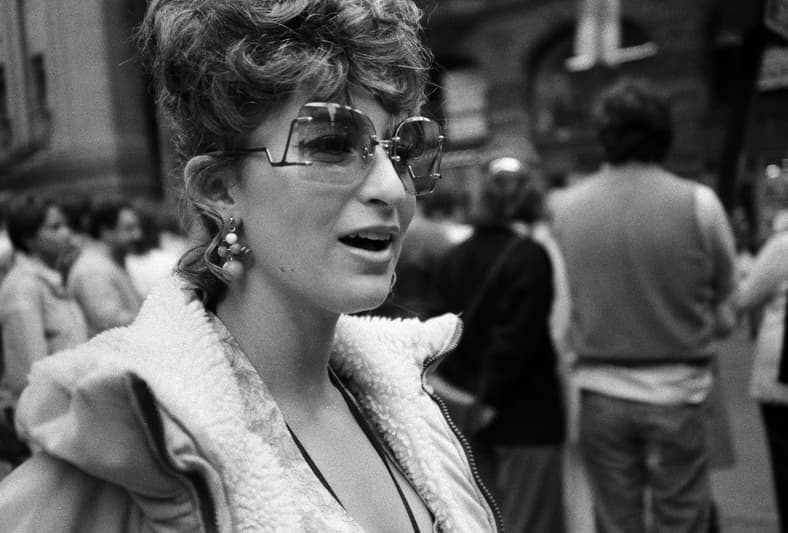
Jennifer Grey, who plays Ferris’ sister, Jeanie, was also on set — even though Jeanie wasn’t part of the sequence.
“I had no one to hang out with because they were all playing all the time,” Grey later said of the bulk of the shoot. “I was very much on my own, so I would get into all sorts of trouble, like one day, remember… I went and I totally disguised myself.” With giant tinted shades, hair up in almost a beehive, and baubly earrings, Grey dressed as an autograph hound and walked all around the parade set.
“I would go up and I would get everyone’s autograph, and John had the security trailing me and said, ‘Keep her away from us.’ I was going up to everyone to see if I could get into the movie as this autograph hound.”
By coincidence, this is also the same day she met the future choreographer of Dirty Dancing – Kenny Ortega.
Richard Edson hung out with Grey on set and they bulls—ted between takes, when she wasn’t harassing her boss and coworkers. “I said something like, ‘God, what would you do without acting?’” Her answer was, “I don’t know.”
Ferris Bueller… You’re My Hero, by Jason Klamm. is available June 16 from 1984 Publishing.
Main image: Matthew Broderick as Ferris Bueller and the “frauleins” on the set of Ferris Bueller’s Day Off. Photo by Ruth Kaufman, courtesy of 1984 Publishing.