
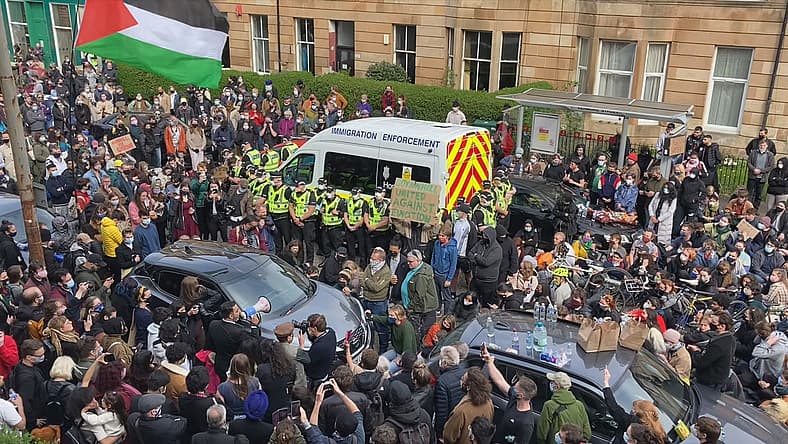
The new Sundance documentary Everybody to Kenmure Street details, minute by minute, a 2021 protest in Glasgow, Scotland against immigration officials who tried to seize two Sikh men from their neighborhood. That neighborhood is Pollokshields, Glasgow’s most diverse community, and its residents rise up almost immediately to defend their abducted neighbors.
The film couldn’t be more timely: It premiered last week just four days after the ICE killing of Alex Pretti, and 21 days after the killing of Renee Good. Their killings have been a tipping point in the national debate about masked ICE agents raiding homes, businesses and other locations in the name of national security, clashing with immigrants and U.S. citizens alike.
In the Pollokshields protest, agents of the Home Office, the British equivalient of the Department of Homeland Security, seized the two men on the first day of Eid al-Fitr, a Muslim holiday that marks the end of the month-long, dawn-to-dusk fasting during Ramadan.
Through text and WhatsApp chains, people immediately took to the streets. One anonymous protestor, who became known only as Van Man, positioned himself beneath the van in which the two Sikh men were held, which prevented authorities from taking them away.
Local police gathered to stop the protesters, but they were vastly outnumbered. And — don’t read the end of this sentence if you don’t want to know what happens in Everybody to Kenmure Street — the Home Office officials released the two men.
The film’s director, Felipe Bustos Sierra, had thousands of hours of phone footage from which to assemble the film, but didn’t want to be held at a digital distance. To better understand the events of the Eid raid — which took place on May 13, 2021, he went for long walks with many of the people involved, trying to understand both the logistics and emotions behind the protest.
Bustos Sierra is intimately familiar with repressive governments: His father was a Chilean journalist exhiled to Belgium after Augusto Pinochet took power in 1973 and became the leader of a brutal right-wing regime. The Chilean-Belgian filmmaker now lives in Scotland.
Over the weekend, Everybody to Kenmure Street won Sundance’s World Cinema Documentary Special Jury Award for Civil Resistance. We asked Bustos Sierra about how the Kenmure Street protest was similar to and different from anti-ICE protests, historical context for Everybody to Kenmure Street, and some interesting celebrity cameos in the film.
Everybody To Kenmure Street Director Felipe Bustos Sierra on ICE, the Home Office, and ‘All of Us’
MovieMaker: Do you see this method of protest — basically overwhelming immigration agents with sheer numbers — as a potentially effective strategy for demonstrators in the United States?
Felipe Bustos Sierra: There’s a choir song in the film during a key turning point of the protest. It’s composed by Barry Burns (of Mogwai) and performed by one of the oldest existing gaelic choir in Scotland. They repeat two sentences in Urdu and Gaelic: “We go together” and “It will take all of us.”
Critical mass is key, I think, along with recording and sharing quickly, ideally for the purpose of attracting more people to join the protest.
MovieMaker: I was struck by how calm the Scottish police seem compared to, for example, the ICE agents who recently shot Renee Good and Alex Pretti here in the United States. Is this a cultural difference, or a matter of training? The police even ultimately decide the two men should be released in order to de-escalate.
Felipe Bustos Sierra: Their reaction, calm in comparison to ICE in the U.S., still felt like an over-escalation and out of step with the situation. The main difference is that the police doesn’t carry guns in the UK and this remove the fast track to violence that feels so readily available in the US.
There wasn’t much cooperation from the police or government bodies for this film. I wish we could have found at more about the final dynamic of powers that day and who took the decision to end it. I suspect overtime pay would have been a factor, another hour would have made the day’s budget balloon and difficult to justify publicly.
We might know more one day, but after nearly five years of work, it didn’t feel essential for our film, which is more of a sensory experience about being part of a protest.
MovieMaker: I loved the surprising turn toward explaining how Glasgow and the UK in general benefited from slavery. Why did you want to include that background in a film about a protest against immigration raids?
Felipe Bustos Sierra: Many people turned up to their very first protest that day. They recognised the injustice in their neighbourhood. A recurring element during those conversations was the frustration for many with it happening on their doorstep and the feeling that no one had ever done anything about it.
In a way, it doesn’t matter what brought them to the street — it was vital that they did turn up — but of course, what a fallacy. People have done or tried to do something about it for decades, centuries, particularly in the southside of Glasgow.
The city benefited so quickly, almost abruptly, from the Transatlantic slave trade and its legacies, creating a new hierarchical class and with it, great injustices. Whether it had to do with universal suffrage, emancipation, civil rights, workers’ rights or migrant rights, certain people over generations have continuously been able to recognize those injustices and taken steps or, at least, attempted to rectify them.
As someone says in the film, “we’re all part of a continuum.” Kenmure felt to me like the latest iteration of an invisible injustice made visible by Glaswegian bodies and I loved making those connections through time.
MovieMaker: Everybody to Kenmure Street suggests that staging the raid during Eid, which marks the end of the Ramadan fasting, was an act of provocation by the Home Office. Yet it backfires, because many of the protestors have spent the last month in fasting and self-reflection, thinking about how they can become better people. And then they’re presented with this opportunity to stand up for their captured neighbors. Can you talk about the remarkable timing of this event?
Felipe Bustos Sierra: I can’t speak to their intentions, as we did not have meaningful conversations with the Home Office or the police. From interviews with people who did make contact on the day or had conversations with those institutions, there appeared to be a mixed bag of intents and perspectives on the day as it unfolded.
It was suggested to me that some were chomping at the bit to intervene more aggressively, while others questioned their own presence there. Pollokshields is Scotland’s most diverse community. While it was irrelevant to the protesters, the Home Office turned up fairly late for a dawn raid on the day of Eid a few doors up from the local mosque to detain two men of color.
It also appeared that the raid was prompted by a deliberately spiteful report, rather than an accurate one. Do they always act on such thin information? Is it on purpose? Was it incompetence? Was it cruelty? Is it part of the Hostile Environment policy? Without them coming forward and meaningfully participate in the conversations, it’s up to the audiences to figure it out based on the footage we had available.
MovieMaker: What was the process of acquiring and editing so much cell phone footage for Everybody to Kenmure Street?
Felipe Bustos Sierra: The protest happened during lockdown and so did much of the initial research. Instead of filming, I would go for a walk around Queen’s Park in our neighborhood with a different participant every other day. This helped get a sense of how the protest evolved, and built trust about the project.
People shared their own footage and pointed me in the direction of others. We amassed so much footage in this way, while also putting regular callouts on social media, but it also got us to more elusive characters like Van Man and the nurse.
Colin Monie, the editor, and I worked on the film in batches over four years, often dictated by chunks of funding trickling in. Footage on social media had provided early a spine for the timeline of the film, but these conversations and the fragments of images that came with each new participant gave it more detail and intimacy. It was a long process, and required some great aftercare in post to conform the different formats, codecs and frame rates.
MovieMaker: There are some surprising moments in Everybody to Kenmure Street where a celebrity appears, reading real words from people who were involved in the demonstration. Why include the famous? Is there a benefit, in terms of marketing the film? Were you worried that they could take people out of the reality of the moment?
Felipe Bustos Sierra: It was a creative decision to get key testimonies into the film where the real participant preferred to remain anonymous, each for different reasons. I felt I couldn’t document what had happened without them, while also finding a way to mirror their own conviction, defiance and humor.
In Glasgow’s history of civil disobedience, there has been some big swings to catch the public’s eye and I enjoyed attempting to match that. It works on different levels for me: it’s often been women and migrants at the heart of resistance movements, doing the unseen hard graft. It felt like poetic justice to gender-swap Van Man (with his consent too). It also brings an element of surprise to the film that, again, felt appropriate to the the protest itself in the way people kept finding ways to disarm the situation.
MovieMaker: I understand your father was a Chilean journalist who fled the Pinochet regime in Chile. Did that give you an affinity for underdogs, and standing up to oppression?
Felipe Bustos Sierra: I grew up with Chilean documentaries, who across a couple of decades, either documented their repression or articulated different ways to express solidarity. Much of that made a deep impression on me and has been part of my own moral compass, although I did have to relearn a lot of it while making this film, as I didn’t turn up on the day of the Kenmure Street protest, despite living only a few minutes away from it.
I didn’t see the hope that morning and missed out on a collective experience I never got to feel in my whole life. I’d forgotten that hope is an active and communal thing. Thinking about it maybe a warming exercise, but it only truly comes alive when you take that step outside to join others.
Main image: Everybody To Kenmure Street by Felipe Bustos Sierra. Courtesy of Sundance Institute.