
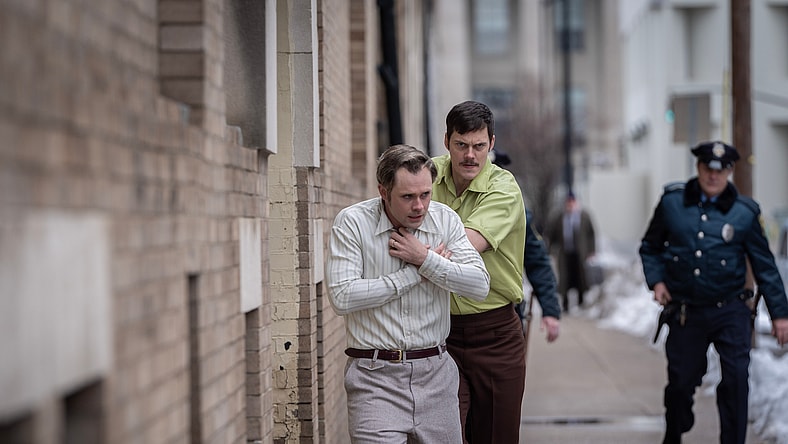
You might not have pegged the guy who breathed life into Pennywise the Dancing Clown, Barbarian’s Keith or Nosferatu’s Count Orlok to film a dramatized true crime movie next. But Bill Skarsgård was watching a lot of 1970s movies and manifesting an actor-driven, “night-of” type story when the opportunity for Dead Man’s Wire came his way.
“It’s just one of those raw performance pieces I was craving at the time,” he says. “So I really jumped on it, terrified.”
The idea of working with director Gus Van Sant was serendipitous and a “no-brainer,” as Skarsgård had been a fan for years. Tackling the true story of Tony Kiritsis was something else though — the actor wasn’t sure he had it in him.
In 1977, Kiritsis entered the offices of Meridian Mortgage Company in Indianapolis and took president Richard Hall hostage for 63 hours. He used a sawed-off shotgun that was wired to Hall’s neck, a device dubbed a dead man’s wire.
Skarsgård was concerned he couldn’t play Kiritsis honestly because he physically looks nothing like him.
“The real guy was in his mid-40s and a foot shorter than me, but Gus wanted me and when I spoke with him about it, the script was great and the story was insane,” says Skarsgård, 35. “I used the real Tony as a spirit guide for the performance and I had so much fun on it.”
For the physical transformation, a wig and moustache helped. Skarsgård felt like Kiritsis was a guy who carried a lot on his shoulders, so he also played him as tense and rigid, and a little hunched over — “from carrying all of that weight.”
The actor also dug into the footage and recordings of Kiritsis available at the time for inspiration, noting that Austin Kolodney’s script included links to the situations he was recreating. Skarsgård also read Richard Hall’s memoir about the kidnapping and watched a documentary on the subject.
Skarsgård initially got so into the role that his performance felt too close to reality. Eventually, Van Sant convinced him to take a more character-driven approach.
“He told me to stop trying to do an impersonation of the real guy,” Skarsgård says. “So I let go and drew on his speech patterns and rage. The real guy had a tendency to get so angry, and then apologize right afterwards. He was so angry, but also kind of funny. There was something endearing about it. At one point I had 17 pages of dialogue, of ranting, in one day.”
In real life, Kiritsis was upset over a $130,000 mortgage he took out with Meridian. He accused the company of sabotaging him once it realized the property was worth more. So he took Hall, played in the film by Dacre Montgomery (Stranger Things), hostage and forced him to walk through the streets until he commandeered a police car and forced Hall to drive to his apartment. He then demanded an apology, $5 million and a promise of no prosecution in exchange for Hall’s safe release.

The film follows those tense events, which means Skarsgård and Montgomery spent a lot of time together on set in Louisville, Kentucky, which stands in for Indianapolis.
Skarsgård says it was his co-star’s idea to lay out blueprints for the dead man’s wire in a pivotal opening scene, which set the tone for the film. They shot it on one of the first days of the 19-day shoot, with two handheld cameras. Van Sant gave them the freedom to improvise and allow moments to happen.
“Dacre and I are both high-energy, opinionated actors and we come with a lot of ideas,” Skarsgård says. “I sometimes describe Gus as this Buddhist, Zen-like energy in general, but also with his approach to filmmaking. He kind of watches and observes, and let me and Dacre yell out ideas until we ran out of steam. Then he gently shaped it in a way, while also letting the film shape itself.”
Skarsgård says there were plenty of spontaneous moments, including in a telephone call scene between him, Montgomery and Al Pacino, who plays Richard Hall’s father, M.L. Hall. The scene wasn’t in the original script, and came at Pacino’s suggestion.
Skarsgård applauds Van Sant for allowing Dead Man’s Wire to become what it is, rather than forcing a vision on it.
“Whenever moments like that happened we just worked off them, and a lot of the funny lines or off-beat moments are improv,” he adds. “They just happened when we were shooting in character and came up spontaneously. It’s lovely when that happens and when you can access it, because you can surprise yourself and find these little gems that you could never really plan for.”
He likens the concept of Dead Man’s Wire to one of his favorite ‘70s films, Mikey and Nicky, in which two long-time friends spend the night running from a mob boss.
“The whole movie is improv between Peter Falk and John Cassavetes,” he says.
Bill Skarsgård on the Challenges of Dead Man’s Wire
One of the challenges the Dead Man’s Wire team faced early on was the design of the titular contraption. Initially the wire was softer, so that it would be more comfortable around Montgomery’s neck. But the device kept falling off in the middle of scenes, so the film had to switch to something stiffer.
“A lot of the scenes are so long that you just don’t ever want to interrupt them,” Skarsgård explains. “And when you do interrupt them, you want to reset and do the whole thing again.”
The film is a tense 105-minute character study of an event that presaged the modern 24-hour news cycle. It takes place during a time of political unrest, economic anxiety and media disillusionment. So there are plenty of current-day parallels.
“To me it felt very current, more current now than if we made the movie 10 years ago,” Skarsgård says. “There’s also this feeling of the little guy getting oppressed by a system and not having a fighting chance. Today, interest rates and skyrocketing costs of living are out of control when we have more billionaires than ever. There’s a lot of anger and it can be directed in any way.”
Dead Man’s Wire also touches on the idea of fame and getting your voice heard, particularly in a world that pre-dates social media. To spread his message at the time, Kiritsis made phone calls to Indianapolis radio star Fred Heckman. In the film, he’s been replaced by Fred Temple, who is played by Colman Domingo. Kiritsis’ phone interviews allowed him to tell his side of the story and turned the incident into a national event. At one point, Kiritsis gave a conference in front of live broadcasters that even interrupted an ABC feed of John Wayne presenting an award.
“I’m sure this story had an effect on the media landscape in some regard,” Skarsgård says. “If you look at the real footage of the press conference, you can see how excited Tony is that this show is all about him and for him. Here’s a guy who never had a voice, has had a tough life, has worked hard his entire life and never gotten a break from it. He feels betrayed and chewed up by the system. This is the moment for him to get that break and climb out of his social class.”

Skarsgård by no means endorses the actions Kiritsis took, but he certainly understands the rage the man must have felt.
He believes audiences will also connect with it — which differentiates the role from some of the monsters he’s played in the past.
“I definitely don’t consider Tony a monster; he’s very human to me,” Skarsgård says. “I tend to try and make the monsters I play a bit human as well, or find something I can anchor them in so they’re not a one-dimensional villain. But when you’re playing someone like Tony, you feel some sort of affection for them.”
He adds that Kiritsis is a sad character who was a victim of his own circumstances, and who on top of that probably had mental health issues.
“I spoke with Gus a lot about it, and Tony was absolutely no monster. And I hope when people see this movie, they don’t consider him that.”
Dead Man’s Wire launches a busy year for Skarsgård. Aside from just returning as Pennywise for HBO’s IT: Welcome to Derry, he stars in 2026’s The Death of Robin Hood alongside Hugh Jackman and Jodie Comer, Emperor with Sophie Cookson and Adrien Brody, and Peter Berg’s The Mosquito Bowl, based on the Buzz Bissinger book about a historic football game.
Luckily, Skarsgård is feeling energized.
“I came out of this film with more energy than I had going into it,” Skarsgård says. “Having to stay sharp and learn those lines and having fun on a difficult shoot feeds my energy. I wrapped Dead Man’s Wire excited and inspired and creatively fulfilled.”
Dead Man’s Wire arrives in theaters Friday from Row K Entertainment.
Main image: Bill Skarsgård as Tony Kiritsis and Dacre Montgomery as Richard Hall in Dead Man’s Wire. Row K Entertainment.