
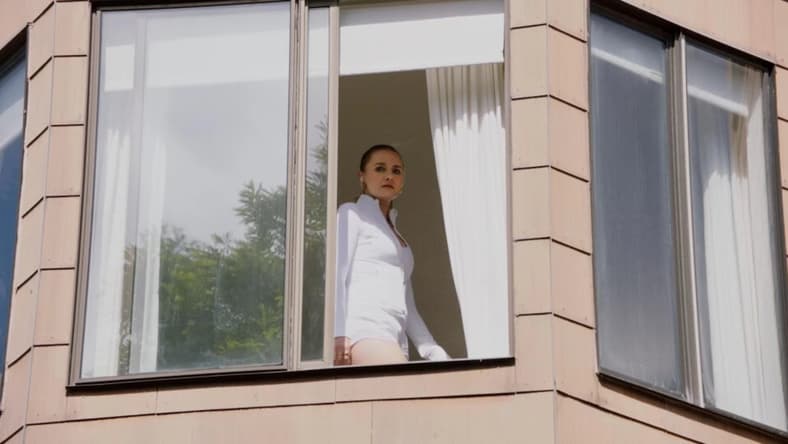
Jenna, the main character in Emily Kent’s transfixing short film “Clean Girl,” seems to be doing everything right: She gets plenty of exercise, keeps her apartment meticulous, and consumes both protein and abundant self-care content. The title refers to the “clean girl” aesthetic, popular on TikTok, that emphasizes a minimalist lifestyle of beauty and apparent effortlessness.
But in the film, which plays today at the Poppy Jasper Film Festival, outside interruptions keep disturbing Jenna’s peace. She’s had a recent breakup, her neighbors are annoying, and the TikToks she hopes will keep her calm instead deliver anxiety.
Kent drew on a stressful period in her own life to write and direct the film, in which Selene Winter Rose plays Jenna with a skillful mix of vulnerability and control. Though Jenna never lets us into her inner thoughts, the film does, as onscreen text displays her anxieties.
Kent recently completed her MFA in Cinema at San Francisco State University, about an hour north of the lovely towns that host Poppy Jasper — Morgan Hill, San Martin, Gilroy, Hollister, and San Juan Bautista. The festival, celebrating its 20th edition, is in a part of California where wineries meet Silicon Valley. “Clean Girl” is a typically inspired choice for the well-curated fest.
We asked Kent about drawing on real life, avoiding feelings, and Edgar Allen Poe.
Emily Kent on Making Her Short Film ‘Clean Girl’
MovieMaker: You said on the “Clean Girl” Kickstarter page that it’s based on a time when you, like Jenna, were dealing with a breakup while working for a startup. Unlike your character, you were also making a film. You wrote, “It was an inconvenient time for feelings, so I embraced my natural inclination to censor them.” That feels very universal in a time when it’s so easy to just put on a video or podcast or to grind through every moment of the day. How did you arrive at this story as a way to express that feeling?
Emily Kent: I started writing “Clean Girl” as a short story exercise for a production class I was in where the focus was sound design. I wanted to show just how easy and destabilizing it can be to spend your entire day disconnected from what is happening around you. I started with the idea of someone wearing noise-canceling earbuds all day long, which is a pretty common sight in a city like San Francisco.
I do it too; you have to, sometimes, because it can get loud. But as I was writing the story, this image took on quite a lot of symbolism and I think it expresses pretty well the lengths we all go to in order to avoid our feelings.
MovieMaker: This has a very well-executed twist, and you build to with this cool sense of menace that comes from something I think we all go through — this pursuit of mental hygiene that can feel very chaotic, because it involves reading and watching a lot of things that may be counter-productive. Without revealing the twist, when in the process did you know what it would be?
Emily Kent: I knew it from the start! There’s a specific Edgar Allen Poe story (no spoilers!) that inspired me to write the film, and I honestly think there’s nothing more macabre than the clean girls I was seeing on TikTok at the time. Edgar Allen Poe would love clean girls. There’s an eerie sort of avoidance that is inherent to that beige lifestyle of maximized productivity that fascinated me and made me want to dive deeper, as it were…
MovieMaker: What filmmakers (or other artists) do you really like and take inspiration from?
Emily Kent: I’m a big Altman nerd and I took a lot of inspiration from 3 Women for this film. His films have a way of capturing the zeitgeist without being trite, and Shelley Duvall’s character, Millie, really embodies what was en vogue at the time for women, to a sickening degree. Obviously I see clean girls the same way.
Chantal Akerman’s Jeanne Dielman also served as inspiration. I tried for some longer takes in my film, and I’m not sure how effective they are in a 14-minute short. But Akerman’s framing of Jeanne Dielman’s character and the slow disintegration of her rituals were a source of inspiration for me.
MovieMaker: How did you find your excellent lead?
Emily Kent: My friend Teresa Fabbricino, who was a producer on the film, was helping me run auditions and she told me that one of her close friends from college would be the perfect Jenna. That was Selene Winter Rose! Selene sent me a self-tape that perfectly embodied the role and it was clear when I talked to her that she felt tremendous empathy for Jenna, so I knew the role was hers! Selene and I also didn’t have much rehearsal time together, but she jumped right in and understood what she had to do, day one.
MovieMaker: I liked the use of the text to reflect her anxieties. It’s like something from old ads, or comics, but also feels very online. How did you arrive at that storytelling device?
Emily Kent: Speaking of empathy! I needed to give the audience a way to really put themselves in Jenna’s shoes and I thought by using subtitles they’d hear Jenna’s thoughts in their own voice, pushing them to empathize with someone they might not otherwise relate to.
My friend Kamila Abdygapparova turned Jenna’s thoughts into colorful, animated subtitles that dance around the frame so, as the viewer, your eye isn’t at the bottom of the screen for very long. Subtitles were also a necessity since so much of the film’s sound was through Jenna’s headphones and LOUD. I wasn’t sure they would work at first, and I was ready to record Jenna’s thoughts as voiceover, but I’m really impressed with what we ended up achieving.
MovieMaker: Your Kickstarter for this film explains that you’re “a filmmaker and barista based in San Francisco where she is finishing her Cinema MFA at San Francisco State.” It sounds almost like the romanticized dream — you have a solid day job, and leave room for your art, while living in a big, adventurous place. I didn’t realize it was even possible anymore in a city as expensive as San Francisco. How hard is it to make it work?
Emily Kent: Yeah, that does sound nice doesn’t it! Since finishing grad school my life has been looking a lot more 9 to 5, and honestly I’m a bit too anxious about money right now to find the space for new creative projects. It does feel like a bit of a self-imposed detox from the overwhelming experience of being in an MFA program for four years (allegedly it’s a three-year program).
MovieMaker: Was this made as an SFSU project? How was your SFSU experience, and how’s your local film community overall? Does Poppy Jasper feel local, or far away?
Emily Kent: Yes, this was my thesis project for the Cinema MFA program at SFSU. I think I would say that it’s really true that you get out of it what you put into it, but it was intense and a little weird at times — usually in an entertaining way. That said, I’m pretty proud of what I achieved, and with this project in particular, the community of my cohort really was invaluable, in particular, Josh Park who produced and edited the film.
I’m still figuring out where I fit in the local film community; I’ve produced a couple delightful short films since graduating, but I am still figuring out what is next for me. And yes, Poppy Jasper does feel far! I had to Google where Morgan Hill is!
Main image: Selene Winter Rose in “Clean Girl,” written and directed by Emily Kent. Courtesy of the filmmaker.