
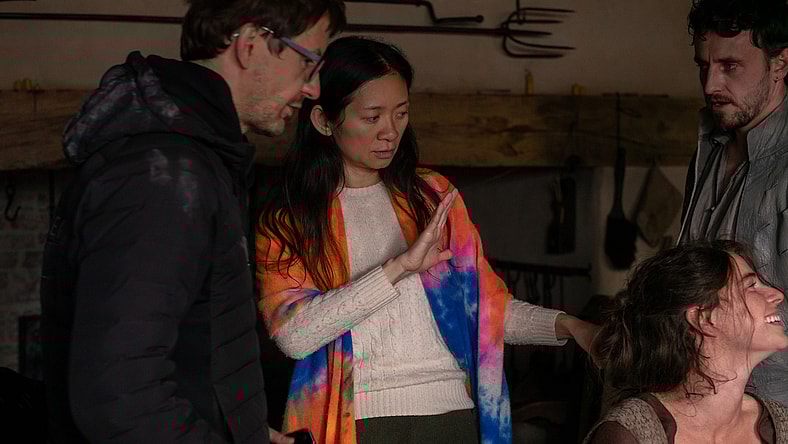
Chloé Zhao has worked with actors who’d never acted before — like Brady Jandreau, the Lakota rodeo star at the center of her 2017 breakthrough, The Rider — and with some of the most acclaimed actors in the world, like Frances McDormand, who won an Oscar for starring in Zhao’s 2020’s Nomadland, which also earned Best Picture and Best Director for Zhao.
Zhao elicits more stunning performances in her latest film, Hamnet, which stars Jessie Buckley and Paul Mescal as Agnes and William Shakespeare as they mourn the death of their 11-year-old son. But she’s noticed that some of the least and most experienced actors share a common quality.
Experienced actors, Zhao says, “know how to hit the marks. They understand why the camera is looking this way, and they understand the process. Great actors have techniques and they’ve trained, and they can deliver depth in layers, and they can deliver paradoxes and contradictions.
“But sometimes professional actors have less of an advantage than the non-professional actors, because the non-professional actors have something given to them that may take the most intense method acting to achieve — which is presence.”
Zhao likes to encourage her actors to live in the present moment and make discoveries during filming, rather than to live, breathe, and sleep to subscribed ideas of their characters. She also wants her collaborators to have the tools to release the emotional weight of the day: She led dance parties at the end of each day’s shooting on Hamnet to help her actors shake off the intensity of the story. And she’s all in favor of “different modalities that can help us get into our body: dancing, dream work, tantric work and breathing exercises, running marathons, martial arts, yoga, traditional Zen meditation, all of it.”
Her films, starting with her 2015 debut, Songs My Brothers Taught Me, embrace patience, improvisation and naturalism, using elegant metaphors to ask big questions. She isn’t good at small talk, which makes dinner parties a pain: “That’s why I don’t go to them, because there would just be silence. People’d say, ‘My God, why’s she talking about something so personal right away?’ I just can’t do it.”
For our latest Things I’ve Learned as a Moviemaker, Chloé Zhao spoke with us about discovery, letting go of pain, and how directing Marvel’s 2021 Eternals was like containing a volcaic eruption. —M.M.
Chloé Zhao: Things I’ve Learned as a MovieMaker

1. When we’re trying to tell a story, or an actor is doing a performance, and when it’s just only coming through us, it feels limited and small. That doesn’t mean it’s not doable. But if people want to ask me what I’ve learned, what helped my career, my work, it’s that something bigger must come through me on a daily basis when I’m creating. Something much bigger must be guiding me.
2. How does that work? You have to get into your body, get out your head, and wait. We don’t compare ourselves to the great prophets, but we can learn from them. They went into the woods, the forests, the deserts and the caves, and they waited, and they put their bodies through something. They starved. They sat in the waterfalls — cold water. You know, they put their bodies through extreme things. Your own egoic self dissolves, and then you become a conduit to wait for something bigger to come. That should happen daily on set, otherwise it becomes mine, which would be too small.
3.I was in Pompeii recently. I’ve been working on a project, discovering an older creative process. Or rather, rediscovering it, and questioning what kinds of ways of creating we have forgotten. And I talked to this woman who’s worked in Pompeii for 20 years, and asked her, what makes a good archeologist? And she said, a good archeologist will come to a site with an idea of what might have happened here, and then, when they start to excavate, one little fragment shows up, and in that very crucial moment, they will let go of their own vision and allow the story to speak through the fragment.
Every day they come to work, face the unknown… and allow enough freedom to let the story speak itself through the fragments, moment by moment. They also need to give some order to the chaos. The discovery is half of the work, but without a container to hold the discoveries, then you just have chaos.

4. I think everyone can be a filmmaker.I believe everyone was born with the creative energy to tell stories. Some of us feel the need to do it more than others out of survival, because some of us, for various reasons, grew up in situations where we didn’t know other ways to express ourselves, to connect with people. There are these unicorns, exceptions, but I would say the majority of my fellow directors, writer-directors, who I know, all share that. Like Shakespeare In Hamnet, it is survival. We had to create.
5. You do not need to hold on to your pain.You do not need to hold on to your trauma and your pain to create. If anything, it hinders your sensitivity and ability to stay open and receive.
6. I like to give my actors different modalities to be able to get in their bodies and stay in the present moment. I want them to stay in the tension between unconsciousness and consciousness, between the known and the unknown, and I believe that is where great performances and discoveries can be found.
So many of the modalities I try to bring to set, and that I encourage my actors to work with, are about setting containers. When they come to set, it’s not about, “Now, you need to be there — get there for me right away.” We have to support them to drop into their body, to start working with their subconscious, and to get into that space, and then it’s an exploration of moment by moment being present — like, “Where is it headed?” It’s up to the filmmaker, the producers, to create a safe container for your actors to transition into the roles.

7. Eternals was a volcanic eruption of all the energy I gathered from making the first three films, learning about the human condition. And I wanted a way to express it. The setup is about a pantheon of gods talking about the nature of humanity and whether we should be allowed to survive judgment — it’s like a Greek play. And the eruption, the lava field, took me about four years to contain and excavate, and to reshape it and to represent it to the world again.
I think what I learned from it is that sometimes the container needs to be really strong to hold that much material, right? And I’m learning to build that container for my own volcanic energy.
Hamnet is now in theaters from Focus Features.
Main image: (L-R) Director of photography Lukasz Zal, director Chloé Zhao and actors Jessie Buckley and Paul Mescal on the set of their film Hamnet, a Focus Features release. Photo by Agata Grzybowska / © 2025 Focus Features