
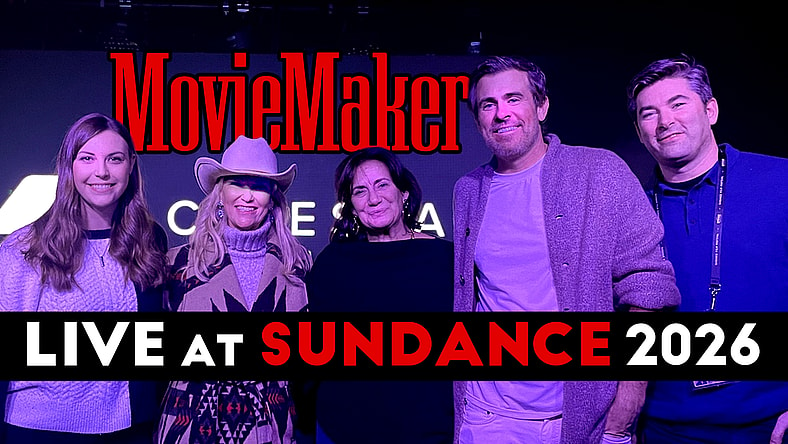
Garrett Patten wishes he and other filmmakers only had to worry about finding the best crews and locations. But the cost of filmmaking means they have to think a lot about taxes, too.
“In the indie film world, the tax incentive is one of the most important things — and also the ease of the tax incentive,” he said at our Sundance 2026 panel on the Best Places to Live and Work as a Moviemaker. “I’ve shot in a couple major cities before where the process to get the tax incentive back was very difficult, and most indie filmmakers are counting on that money for post production. If it takes two years to get your tax incentive back, it doesn’t help that much.”
Tax incentives — along with crews, locations, and sheer livability — are among the factors we take into account when we compile our annual list of the Best Places to Live and Work as a Moviemaker. At Sundance, we were honored to host a panel discussion highlighting three of locations on our Best Places list that excel in all of those areas: Santa Fe, Massachusetts and Fort Worth.
The panel also included Eion Egan, co-CEO CineSpace, which offers top-tier studio facilities in six locations. He offered insights into how crews and local policies contribute to a thriving film community — and how CineSpace chooses locations for its industry-leading studios.
Patten, meanwhile, provided a filmmaker’s expertise: He’s fresh from making his new short thriller “Self Custody,” in which he plays a struggling dad desperate to reclaim his Bitcoin fortune.
The Best Film Incentives, Locations and Crews
Fort Worth Film Commissioner Taylor Hardy is the point person in a region that currently hosts major Taylor Sheridan productions like Landman and Special Ops: Lioness, as well as many other projects of all sizes. Sheridan and 101 Productions, which produces his shows, are among the partners on a new 450,000-square-foot film and TV production campus in Fort Worth.
The Texas Moving Image Industry Incentive Program recently increased the grant rebate available to productions to 31%, and Hardy noted that many prominent industry professionals are relocating from L.A. to the Fort Worth area. They’re drawn not just to work, she said, but also quality of life.
“It’s just a fun city to be in,” she said on the panel, which you can watch here or above. “We’re the 11th largest city in the US, which people don’t realize — so it’s a big city, but we have this small town feel. It’s easy to get around. People are really welcoming. It’s this great community. … With the lower cost of living, people are able to go out and have this great dining and nightlife, and go two-stepping or to a rodeo, and it’s just a lot of fun. And I think it’s important to think about that total experience, not just your time on set.”
Meg Jarrett, director of the Massachusetts Film Office, noted that her state has a long-established crew base matched by strong incentives of up to 25%, with a $50,000 minimum spend and no caps — “you could film 100 movies there a year, if you wanted to,” she said.
Jarrett noted that many filmmakers who grew up in New England sometimes go to New York and L.A., but find their way back for specific projects. Besides obvious ones like Matt Damon and Ben Affleck, she noted that New Hampshire-born Adam Sandler loves to film in neighboring Massachusetts — “he’s probably spent the most money in Massachusetts filming,” she said.
Siân Heder, writer-director of the Best Picture winner CODA, also came home to Massachusetts to film the story.
“She grew up in Cambridge, Mass, and she summered in Gloucester and she rewrote this French teleplay to be CODA as an homage and a love letter to Cape Ann, where she spent her summers and had her memories, and that turned into an Oscar,” Jarrett noted.
Santa Fe, meanwhile, has drawn massive projects like the Best Picture winner Oppenheimer through a mix of stellar locations, concierge-level attention to filmmakers, and some of the best incentives in the country, which can climb as high as 40% in parts of New Mexico.
She said Santa Fe, a refuge for many A-listers looking for an escape from the hustle of New York and Los Angeles, excels at bringing people together.
“We have the resources, we have the stages, we have the sets, we have the locations, we have the quality of life, but then also we are also a connector,” LaBar-Tapia said. “We really want to make sure that everyone knows where everybody is, and that we can bring all of our Santa Feans to work together.”
How CineSpace Chooses Where to Set Its Stages
Egan noted that CineSpace is based in locales that make a long-term commitment to film, including Toronto, Chicago, Los Angeles, Atlanta, Wilmington, North Carolina, and Babelsberg, Germany. Toronto and Chicago, like Fort Worth and Boston, are on our Best Places list in the bigger cities category.
“We make a decision based on the longevity of these film communities — they’ve gone through all sorts of cycles over many decades,” he said. “And it’s great to see multi-generations of film crews working on our lots. But I think the biggest thing is policy — if your government is willing to support.”
He added: “It’s all about incentives. So we’re not in any states that don’t have incentives. We’re in states that have a very rich crew base. We’re also located in a kind of 30- to 35-minute radius out of the cities, these big urban communities. We’re nothing without the communities we’re operating in.”
While many in the industry lament the slow pace of filmmaking in Los Angeles at the moment, CineSpace believes in its future. The company is opening a new facility in Woodland Hills.
“Greenlighting production and financing production seems to still really come out of L.A,” noted Egan. “I don’t see that changing.”
He added that while many studios are setting up hubs in other cities, in Los Angeles, “there’s quality production, and they still need quality infrastructure.”
The Next Generation of Crews
CineSpace, Santa Fe, Massachusetts and Fort Worth all prioritize programs to bring new people into the industry.
LaBar-Tapia noted that New Mexico’s Film Crew Advancement Program will cover up to 50% of the salary of film and TV professionals training up to a higher job, for up to 1,040 hours.
“If someone comes in as a PA and they can get trained up in something, the state will actually pay for 50% of that salary to train up,” she said. “Our goal is to keep our filmmakers and keep the crew and keep everybody in New Mexico.”
Massachusetts, meanwhile, has crews who have been working for decades, but also new people entering the industry every year.
“Our crews are now, I would say, five to seven deep,” Jarrett said. “Especially with independent films that come in, they may have veteran crew members on the crew list, but they also bring in new crew members programs.”
She noted that the Massachusetts Production Coalition offers training programs for PAs, editors, camera operators, and more.
Hardy said Sheridan’s productions have been a huge boost for local industry opportunities: “He may be hiring over 1,000 people when you think about day players and everyone involved,” she said.
To meet the demand, Fort Worth partnered with 101 Studios and the city’s Tarrant County College to improve “areas where we saw gaps in our crew base — so things like set construction, hair and makeup, grips and gaffers,” Hardy said.
“We created a fast-track certification program to take people who maybe already had these existing skills to teach them how to apply that to work on set,” Hardy said. “It’s been very successful. We launched just over two years ago, and have already had 200 students register, and several of the graduates have gone on to work for Taylor Sheridan. One of them now has a full-time position and worked on Landman and Lioness.”
CineSpace, meanwhile, has its own training program, CineCares, which opens up opportunities for people living in the communities where CineSpace has facilities.
“With NBC Universal, we started in Chicago on the “One Chicago” Dick Wolf shows, which is still getting new grads. We’re working in comunities that wouldn’t traditionally be very familiar with working in film and television, low-income communities,” Egan said.
CineCares works with DePaul University in Chicago and York University in Toronto, and pays special attention to one of the sometimes overlooked jobs in the industry: “There’s never enough accountants, people. We need more accountants,” Egan noted.
What to Think About If You Want to Shoot in a New Location
The Best Places panel included several other topics we covered in the video, including whether Los Angeles will still be the entertainment capital in five years. It ended with some advice on what to do if you’re thinking about shooting somewhere new.
Patten said he had learned firsthand that finding a good team is crucial.
“If you’re going to a place that you don’t know, finding a great line producer and getting the crew involved is probably number one,” he said. “But then number two would be the logistics: Obviously you’re going to be bringing some cast, you’re going to be bringing a lot of people in from other areas as well, and lodging and all the things that go along with that are part of the process.”
The local film commission can help. Here again are links to contact Santa Fe, Massachusetts and Fort Worth. And if you need studio space, click here for CineSpace.
Main image: (L-R): Fort Worth film commissioner Taylor Hardy, Santa Fe film commissioner Jennifer LaBar Tapia, Massachusetts Film Office director Meg Jarrett, director-producer Garrett Patten, and Cinespace co-CEO Eoin Egan at our Best Places to Live and Work as a Moviemaker panel at Sundance 2026.