
Aditya Ezhuthachan is an attorney focused on entertainment law with Beverly Hills-based Pessah Law Group. In his latest Legalities column, he addresses the law around telling based on a true story narratives, and questions like whether you need someone’s life rights to make a biopic.—M.M.
Audiences are consistently drawn to stories based on real people and events — from Erin Brockovich to true-crime podcasts, real-life stories mean real stakes and real consequences for real people. Although fictional stories can inspire, educate, and even enlighten, true stories offer a unique level of authenticity and relatability. “Based on a true story,” “inspired by real events,” and “ripped from the headlines” have become familiar phrases highlighting these shared, compelling characteristics.
True stories are fair game for adaptation into film and television because the First Amendment protects filmmakers’ right to free expression and the public’s right to receive “newsworthy” information. Although U.S. courts have not clearly defined newsworthiness, it is generally understood as information that serves the public interest or involves public figures.
Importantly, since facts about real events and people’s lives are not copyrightable, the legal doctrine of fair use — which allows limited use of copyrighted material without permission — does not apply here. Instead, a body of law encompassing individuals’ rights must be balanced against filmmakers’ First Amendment protections.
Legal Guidelines on Life Rights and ‘Based on a True Story’ Films
The right of privacy safeguards an individual’s personal life, preventing intrusion into private spaces, public disclosure of private facts, portrayal in a false and offensive light, or misappropriation of name and likeness causing emotional harm. The right of publicity is a property right that allows individuals to control and profit from the commercial use of their identity.
Defamation occurs when a false statement of fact — written (libel) or spoken (slander) — is communicated to a third party causing reputational harm. These legal claims often overlap, creating a complex landscape for filmmakers adapting real stories.
Audiences understand that creative license is used to shape narratives and amplify drama. Still, when films blur fact and fiction without clearly distinguishing the two, it exposes filmmakers to significant legal risk. In recent years, Netflix has faced several high-profile lawsuits arising from dramatizations of real people. For example, Netflix settled with a prosecutor who said she was falsely portrayed as racist in 2019’s When They See Us, which dramatized the Central Park Five case.
How can filmmakers reduce these risks for a film that’s based on a true story? First, ensure the story is genuinely newsworthy, and avoid including unnecessary private details. Second, use disclaimers that clarify certain elements are fictionalized; while no disclaimer eliminates all risk, it may influence whether a reasonable viewer perceives events as factual or dramatized, which a future lawsuit may hinge on. Third, when possible, fictionalize or create composite characters to prevent identification of specific individuals.
If depicting real people is unavoidable, avoid negative characterizations unless they are verifiable and well-documented. Furthermore, maintain documentation of all factual representations, including which reliable sources were used and that creative choices were made responsibly.
An ideal safeguard would be to secure “life rights,” a contractual agreement in which the subject consents to their depiction and releases potential legal claims. While not legally required, obtaining life rights provides greater creative freedom by avoiding potential disputes.
Filmmakers should also consult an entertainment attorney during development and through production to identify issues early, draft life-rights agreements, and assess the sufficiency of disclaimers, marketing language, and other mitigation efforts. With thoughtful preparation, ethical storytelling, and legal diligence, filmmakers can balance authenticity with accountability—allowing truth-based stories to resonate without crossing the line into liability.
Please note that the information presented here is meant to be educational in nature and to provide a broad overview of the topic discussed. Filmmakers should always consult an experienced entertainment lawyer to identify and analyze the risks their projects may encounter, especially when telling true life stories involving real people.
Got a film-related legal question? Email Aditya Ezhuthachan at [email protected].
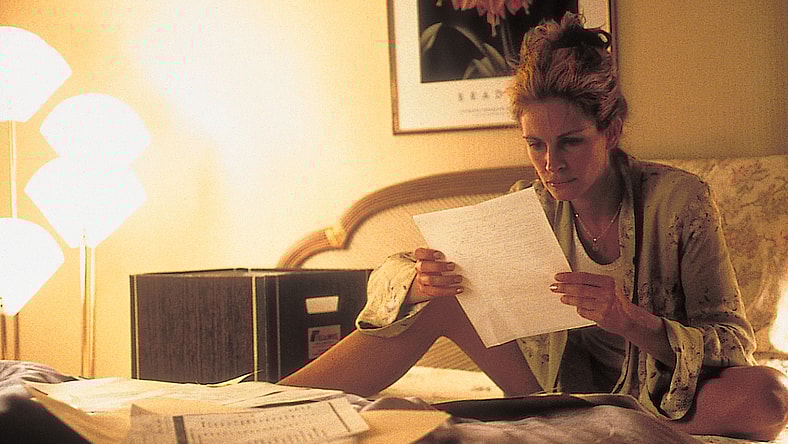
Main image: Erin Brockovich, a based on a true story movies that is actually pretty true. Universal Pictures