

Malik Hassan Sayeed reached back in time to shoot Luca Guadagnino’s After the Hunt.
“In this film, we didn’t go forward with technology,” Sayeed explains. “We went back to where I felt was a sweet spot in technology. We shot film, and we also set for ourselves very specific parameters.”
His only two references, he says, were cinematographers Sven Nykvist and Gordon Willis — “in very specific periods in their careers.”
Sayeed focused on the decade of Nykvist’s work that included Ingmar Bergman’s The Silence and Persona and ended with Nykvist winning the best cinematography Oscar for the Swedish director’s 1972 Cries and Whispers. And Sayeed focused on Willis’ work from 1977 to 1988, a period that included the Woody Allen comedies Annie Hall, Manhattan and Zelig.
“What Luca wanted to do was put some restraints around the technology that we used, so it only functioned inside of that time. And I feel that was an amazing and incredible exercise for us to do,” Sayeed says. “We only used lighting units from that time, we only used lenses from that time, and film cameras within that timespan as well.”
The result is a very modern drama starring Julia Roberts, Andrew Garfield and Ayo Edebiri that looks and feels analog.
“I’m not sure the technology is going in an interesting direction,” Sayeed says, “because digital is just an emulation. It’s not an organic process, it’s code. I’m more interested in the organic than I am in code.”
Malik Hassan Sayeed on Working With Spike Lee and New York City
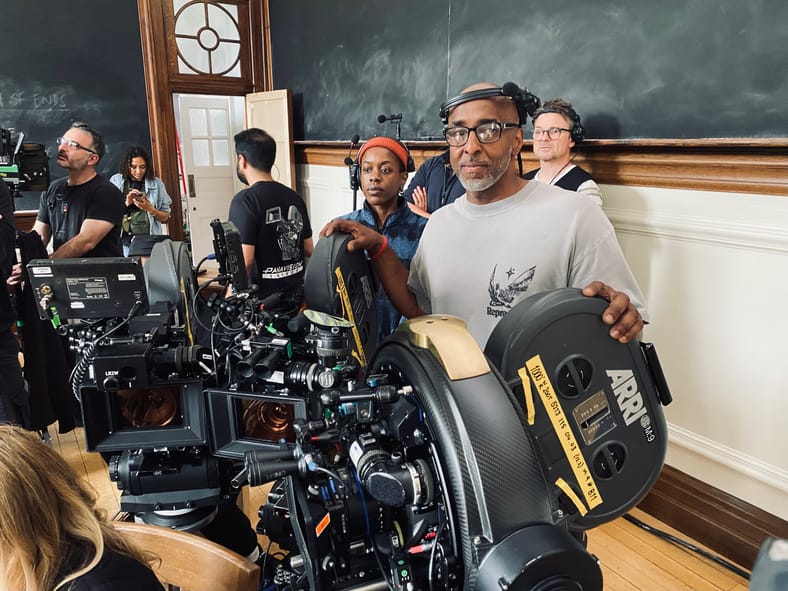
Sayeed, who was born and raised in New York City, was the cinematographer for Spike Lee’s ’90s films Clockers, Girl 6 and He Got Game. He also shot Hype Williams’ 1998 Belly and videos for music icons including Nas, 2Pac, Jay-Z, Lauryn Hill, and Beyoncé.
He is known for keeping an eye out for cinematic images on location in his endlessly photogenic hometown. But After the Hunt was shot mostly on stages, forcing Sayeed to adapt.
“I’m a New York-based, foundational location cinematographer,” he says. “We do not shoot on the stage. I think I’ve never shot on a stage in New York.”
But constructed sets offer more control, which Sayeed says is why Guadagnino decided to shoot for five weeks on stages and backlots at Shepperton Studios, near London.
“I think he was kind of slightly burnt out on the exercise of shooting locations,” Sayeed says.
Environmental control comes at the expense of happy accidents born from natural conditions. Which made Sayeed even more determined to evoke spontaneity.
“We are basically hunters of that magic. This is what we look for, we find, and search out in physical reality,” he explains. “A light bounces off a window across the street; it’s doing something interesting and coming in this way. We’re constantly looking for that. In this context, you don’t have that, so you have to almost manufacture it.
“We’re trying to manufacture the happy accident,” he continues, “and this is what me and my gaffer are constantly doing with lighting. We’re looking for the thing that the light happens to be doing that it wasn’t intended to do.”
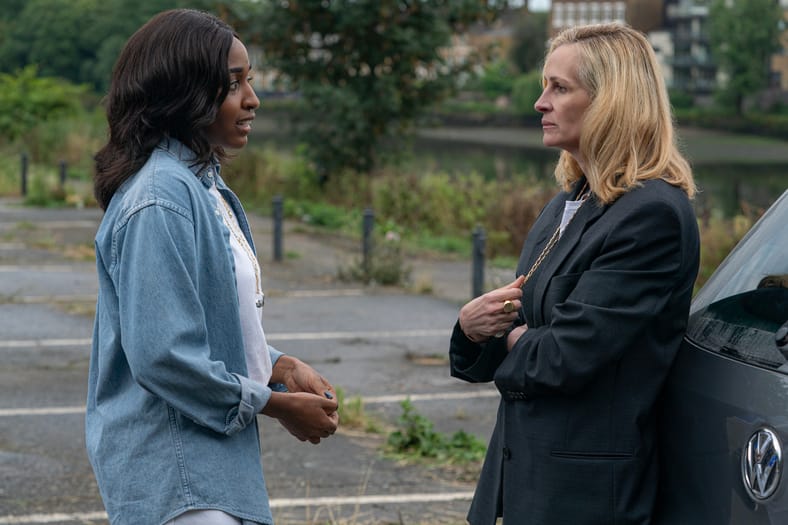
After the Hunt follows Roberts as a Yale philosophy professor entangled in a campus scandal when a close colleague (Garfield) is accused of sexually assaulting her own pupil (Edebiri).
Sayeed recalls catching a glimpse of a happy accident while pre-lighting one of the film’s most dramatic scenes, in which Garfield’s character crashes Roberts’ classroom to confront her.
“I saw it as we were moving around — the side of the light was producing the best quality of light,” he explains. “So we took a bunch of the lights that would do that and just used the side of the lights to light the scene, as opposed to directly lighting the scene.”
The classroom scene was one of the few shot on location, using Cambridge University as a stand-in for Yale. The bulk of the production demanded Sayeed work with green and blue screens, requiring frame-by-frame VFX compositing in post-production to seamlessly blend the action in the foreground with the environment in the background, which was shot separately in New Haven, Connecticut.
“Some scenes were shot inside that were supposed to be outside, but we made it look like it was outside,” he says. “It was a lot of that kind of work on this, so it was a different kind of project for me.”
So different, in fact, that Sayeed was uncertain about how it would all come together in the end.
“I wasn’t sure that we were going to land the plane based on all of that effects work,” he says. But he credits the “phenomenal” post-production team for piloting the film to a very satisfying completion.
After the Hunt and the Search for Silver Linings
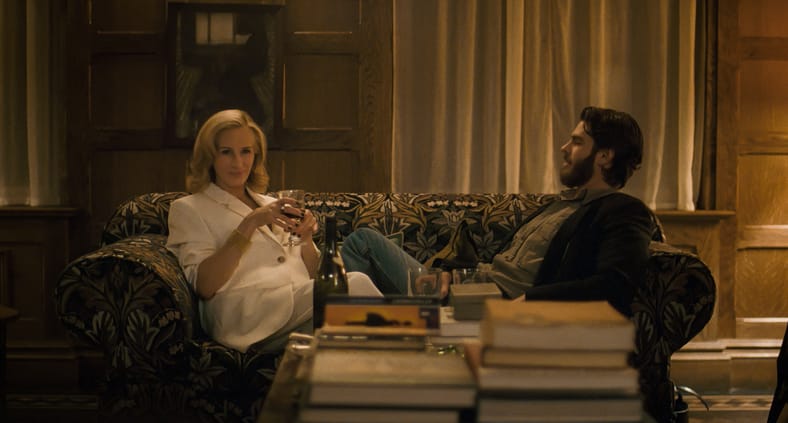
For Sayeed, cinematography is about searching and receiving. He’s constantly looking for a glimmer or a shimmer that will inspire his next move behind the camera — a practice that has prepared him to embrace hardship on and off set.
“I’m a silver-lining hunter,” he says. “I am searching for the silver lining at this point. I’m embracing it. Because this is what we’re constantly looking for and looking to receive. So, if we embrace it, that means we have to embrace the hardship that comes with the silver lining.”
Sayeed recently worked with Guadagnino on the upcoming Artificial, in which Garfield will play Sam Altman, the CEO of OpenAI and one of the key figures in the artificial intelligence boom.
Despite promises that AI will automate our lives in ways we never imagined, many — including some who work in the field — believe it may also be a source of great human hardship in the coming years. They fear lost jobs and incomes, an increasing wealth gap, and the loss of artistry, as well as the potential environmental threat of data centers sucking up water to cool hardware.
For all the concerns that the dystopian Terminator 2: Judgement Day and The Matrix may soon look like documentaries, Sayeed believes AI competition will compel humans to make art that only humans can.
“I feel like it’s an opportunity for humans to not accept mediocrity. We have to be greater. We have to privilege human greatness, because a computer can copy mediocrity, but it can’t really copy human greatness,” he says.
“This is an opportunity for us to privilege that, and put that at the fore, and stop accepting things that are not the greatest that we can do.
“And to me, that would be a silver lining for us in this moment, that we push it, and we’re forced to push it because of what we think AI is going to do to us, and how it’s going to harm us. I think we’re greater than that. We’re way greater than that at our best.”
After the Hunt is now in theaters, from Amazon MGM Studios.