
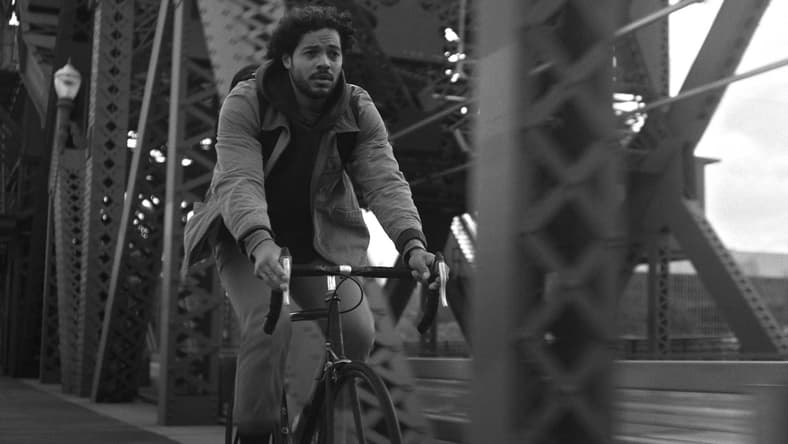
After the 2008 financial crash, Portland writer Evan P. Schneider wrote a novel called A Simple Machine, Like the Lever that told the story of a young man who adopts radical thrift to try to get out of debt. It gained a cult following thanks to its tight writing and examination of the idea that possessions come at the cost of freedom.
When filmmaker Mark Hoffman read the book, it reminded him of a quote from transcendentalist author Henry David Thorough: “The cost of a thing is the amount of what I will call life which is required to be exchanged for it.”
That quote begins A Simple Machine, Hoffman’s adaptation of Schneider’s book, which continued its film festival run Friday with a very warm reception at Dances With Films New York. The film, co-written by Schneider, stars an excellent Richard Blackmon as a version of Nick Allander, the protagonist of Schneider’s 2011 novel. Gabriela Quezada plays his girlfriend, Marie, who wants Nick to grow up, but is uncomfortable with the extreme measures he undertakes to pay off $100,000 in debt, mostly from student loans.
The film fascinatingly addresses, with precision and detail, something that most movies gloss over: the finances of its protagonist. Nick’s biggest early move is to sell his car in favor of a bike, which becomes a metaphor for self-sufficiency.
When he read the novel, Hoffman was struck by how personal it seemed to be. It was especially relevant in Portland, a city with a strong history of social justice, bicycling, and DIY culture. And it’s relevant to almost everyone in America, as affordability becomes one of our biggest worries.
“It was more like a journal of the author — it was pretty autobiographical as well — a young guy trying to figure out what he wanted in life with all these other things going on,” Hoffman said at a post-screening Q&A Friday. “But it was very much focused on mathematically, how your things and stuff equal the freedom spent.”
He added: “It really struck me that we live in a free market country and the capitalistic system, and there’s good and bad that comes with it — but how does the individual survive in that framework?”
Hoffman worked with Schneider to adapt the book into a film, but “at some point he let me just keep going with it,” Hoffman said. His changes included focusing more on the dynamics between characters.
Schneider turns up in A Simple Machine as an angry driver who yells at Nick for riding his bike in the road — an especially fun moment if you know of Schneider’s devotion to cycling.
Mark Hoffman on Shooting A Simple Machine in Black and White
The film is set in the days soon after the Covid lockdowns, and is shot in black and white in part to freeze it in the past. (Kevin Fletcher handled the beautiful cinematography.)
“We wanted it to always sit in that time period, so making it black and white was a reason for doing that,” said Hoffman. “And also, Portland’s a very noir feeling city, and I just thought it would stylistically be cool to have a Portland film that was black and white. There’ve been a lot of great indie films out of Portland, but none that I know of that are black and white.”
The stellar cast also includes Brad Carter, who plays Karl, an unhoused man who becomes a kind of bicycle-repair guru.
Blackmon played college football before turning to acting, and has the kind of magnetism that could easily translate to film stardom. Because he came to acting relatively late, Hoffman said, “he just brings so much life experience.”
Hoffman and A Simple Machine producer Mike Lay said at the Q&A that the film will remain on the festival circuit for a few months, and then they hope to tap into cycling communities to spread the word about it. They’re considering self-releasing, and hope to start their theatrical run in Portland.
It’s a film worth giving up 98 minutes of your life, which is required to be exchanged for it.
You can read more of our Dances With Films New York coverage here.
Main image: Richard Blackmon in A Simple Machine.