

A Man on the Inside creator Mike Schur followed an enviable and proven path to success — the same one taken by Conan O’Brien, Greg Daniels, and Colin Jost, among others. He worked on the Harvard Lampoon, then landed a writing job on Saturday Night Live.
But his career was just beginning.
Schur is one of the most prolific creators and showrunners in TV history. After leaving SNL, he joined Daniels on the American adaptation of the British series The Office, then worked with Daniels again to co-create Parks and Recreation. From there Schur co-created Brooklyn Nine-Nine with Dan Goor, and went on to create The Good Place and co-create Rutherford Falls.
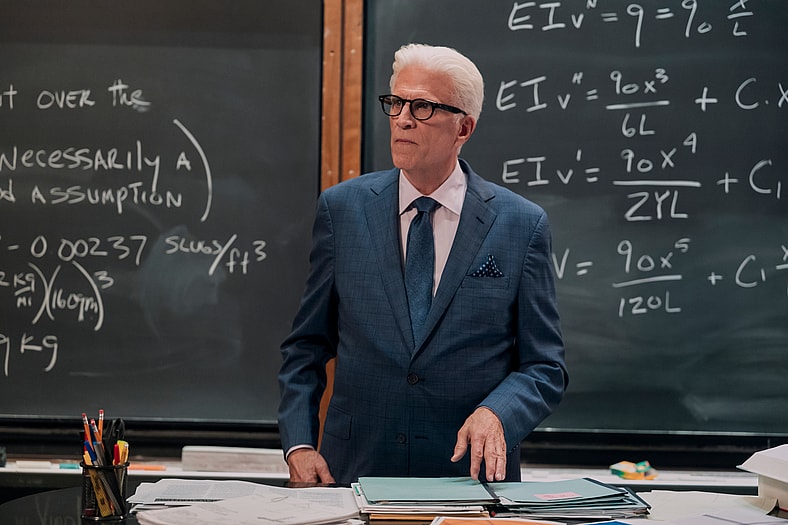
He returns today with Season 2 of Netflix’s A Man on the Inside, which he created based on the documentary The Mole Agent. It re-teams him with The Good Place star Ted Danson, who plays a widowed professor,. In Season 1 he went undercover in a nursing home to investigate theft, and this season he’ll go undercover at a university. Season 2 will also pair Danson with his real-life wife Mary Steenburgen, both of whom Schur honored at the Emmys in September.
Schur has also served as an executive producer of Master of None and Hacks, and his many other credits include co-writing the devastating “Nosedive” episode of Black Mirror. He’s currently working on the upcoming series Dig with Parks star Amy Poehler.
But Schur is also prolific when not working in television. For 12 years, he has co-hosted The PosCast, a podcast mostly about baseball that tends to drift into other subjects as well. And he’s behind the Ken Tremendous social handle, where he wittily bounces from observations on baseball to television to politics. One recent day — following Jimmy Kimmel being pulled from the airwaves at the behest of the Trump Administration — he wrote succinctly: “I’m a single issue voter, and my issue is ‘the government shouldn’t be fascist.’”
How sharp is he? So sharp that when, during our interview, we struggled to remember the word referring to the love words, he quickly suggested: “logophilia?”
But when we pressed him on how he became so productive, he stressed pragmatism, not preternatural recall.
And gave a lot of the credit to his many collaborators.
Mike Schur on SNL and Weekend Update
MovieMaker: Not everyone who’s a writer on SNL goes on to create or co-create so many shows. How did you become a showrunner, many times over?
Mike Schur: There are sort of two big jumps, I would say. The first was at SNL. Weekend Update is its own little mini show within a show. It’s a 10-minute chunk of the show that requires its own little staff.
After I’d been there for a couple of years, my friend Rob Carlock had been running it with Tina Fey and Jimmy Fallon anchoring, and he left to go write for Friends, and I remember thinking, “Who’s gonna take that job? That seems hard.” And then SNL producer Mike Shoemaker was like, “Hey, we want you to take over Update.” And I was like, “I don’t know how to do that. What are you talking about?”
He said, “It’s easy — you’ve got a couple writers, you write a bunch of jokes, and you go through the jokes, you pick the best jokes, choose graphics, you do this, you do that. Yeah, it’ll be fun.” It was an early lesson in the fact that sometimes it seems like, “Wow, the people who are running that or doing that job must really know what they’re doing” — and no, they don’t. They were just there at the moment that they needed someone, and they stepped in.
MovieMaker: This was at the start of the 2001-2002 season.
Mike Schur: Two weeks before the first show, 9/11 happened. … And I kept thinking, “Well, surely someone will say, ‘We shouldn’t leave it in this dude’s hands.’” But they said, “This is your thing. Figure it out.” Tina and Jimmy had been doing it for a year already, and they were already very beloved. And Mike Shoemaker was always around, and other people were around to help. But it just became clear that I had to grow up very quickly and figure out how to kind of command a little platoon unit.
MovieMaker: And you were 25.
Mike Schur: Again, I need to emphasize this: I did not do this alone. There were three full-time writers. There was a co-producer named Scott Weinstein, who was great. Mike Shoemaker was around. Obviously, Tina is herself an incredible producer. This was a big team effort, but I did think: “If I don’t kind of grow up a little bit right now, I’m in trouble.”
So that was a big leap from just being a guy who wrote sketches to a person who had some actual responsibility, and doing that job for three years, I think, really prepared me for show running in general.
Show running is infinitely more complicated than producing Weekend Update. But for Weekend Update, you had to call edits of things, and you had to make quick decisions, and you had to be very decisive. And you had to scramble a little bit between dress and air to make sure that things went well. And you had to manage talent, and you had to do all of the things that you have to do as a show runner — on a small scale, but you had to do them all. So that was the first step.
Mike Schur on The Office and Learning From Greg Daniels
MovieMaker: What was the second?
Mike Schur: The second step was, I left SNL and went to work for The Office, and Greg Daniels, who had adapted The Office, was not just a show runner, but he was a teacher. He was a professor.
I had met with hundreds of people – executives and producers and show runners and people who had written pilots — and when I met with Greg, I sent my agent an email that said, “I don’t think adapting The Office for American television is a good idea at all, but if that guy hires me, I’m going to take the job, because I feel like he’s going to teach me how to write.”
If you’re trying to make the jump from New York late night to L.A. primetime, you need a mentor. You need an instructor. You need a sensei. And Greg was just so thoughtful and scientific in the way that he approached the job. I just had this feeling: “I need a person like that to tell me how to write.” Forget showrunning at that point — I just wanted to be learn how to write.
Working for him is like taking a PhD-level class in writing for TV. I often took notes during the day, as if I were in a class.
MovieMaker: Do you remember any specific eye-opening moments?
Mike Schur: Someone would pitch something, and Greg wouldn’t just say “No,” or, “I don’t think so, let’s keep pitching.” He would say, “I don’t think that will work, and here’s why.” And then he would explain. And sometimes it could be frustrating. But if you tuned in, it was incredibly eye-opening, because you weren’t just getting rejected. You were learning why you were getting rejected. I found it wonderful.
MovieMaker: It seems like you’re writing constantly.
Mike Schur:For better or worse, my approach to this has always been, if I think something sounds fun or interesting or challenging, I say yes, and if it doesn’t, I say no. And there have been times that meant that there was only one thing I was working on, and there were times when that meant there were five things. And it’s important to note that I’ve rarely done them alone. Most of the things I’ve done have been in collaboration with other people, which makes it more fun. I loved the the SNL world, and The Office was very much like that, too.
Most of the things that I’ve done have been with a lot of other people involved. If you just look at my IMDb page, it looks like I somehow have 40 hours in the day, but really that’s because most of those things are being done largely by other people, and I’m playing some role in them: I’m overseeing or producing or advising or being a consigliere in some way, but the hard work is being done by other people.
Like Hacks: Jen Statsky had worked with me on The Good Place and on Parks and Rec, and she and Paul W. Downs and Lucia Aniello, who created that show, came to me after The Good Place wrapped and said, “We have this idea,” and pitched it to me. It was fully formed and vibrant and real and three-dimensional in every way that you could ever hope a show could be.
My joke since then — when people ask what I do on Hacks — is that my number-one job was giving them directions to Warner Bros. so they could pitch it. That’s a show that I am so proud to be associated with, but not a show I’m actively working on every day at all. That’s their show, and my role has been to advise when they want me to, and to give them notes when they want me to, and otherwise to stay the hell out of their way.
Mike Schur on A Man on the Inside, Ted Danson, and Demographics
MovieMaker: One thing you always used to hear is that networks and streamers want younger audiences, but you decided to build A Man on the Inside around a Ted Danson character who’s a retiree. Why did you want to do something so potentially risky?
Mike Schur:One, I love Ted, and if I could write for Ted for the rest of my life, I’d be perfectly happy. Two, I thought the movie that it was based on, The Mole Agent, the documentary, was just a lovely movie that really struck a chord with me. I’m also turning 50 in a couple months, and my generation, our generation, is now facing all of these issues with our parents, and we’re going to be in their position in another 20 or 25 years, right?
So it’s all in front of us, and we can see it coming, both with our own parents and then our own lives.
And I just thought it was tapping into something very fundamental and true about the human experience, and when I’m trying to figure out what I want to write next, I don’t get much past that: “Is this something that’s interesting and real and true?”
But then also, you know that old adage of “Oh, the 18 to 49 demo, blah, blah, blah, blah, blah” — that’s gone now. That was based on advertisers. Now it’s based on subscribers.
There’s a whole lot of people over the age of 65 who have Netflix subscriptions, and they’re going to want to see stuff that they like. Netflix’s whole attitude is, “We’ve got to appeal to everybody.” They’re trying to make everyone in the world want a Netflix subscription.
Also, I don’t know anyone of any age who doesn’t like Ted Danson and doesn’t like watching him act.
A Man on The Inside Season 2 arrives on Netflix on November 20.
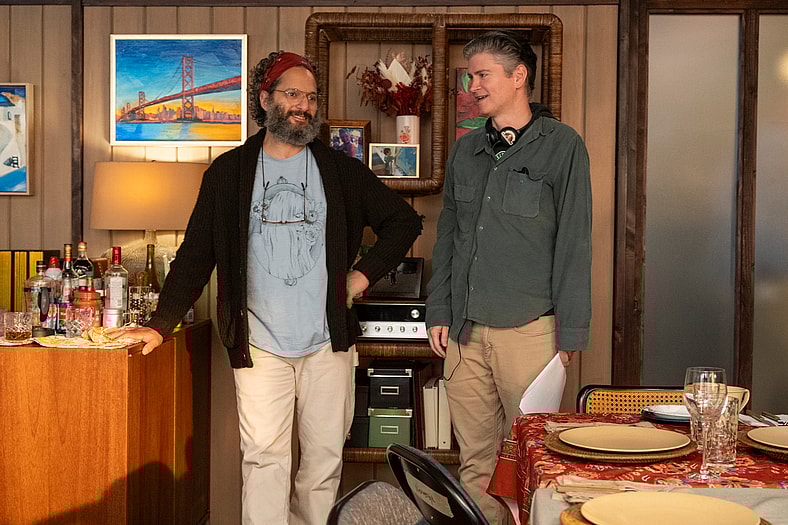
Main image: Executive producer and director Mike Schur, left, with actor Sam Huntington on the set of A Man on the Inside. Photos by Colleen E. Hayes/Netflix © 2025
AMOTI_204_Unit_00202RC.jpg: Ted Danson’s character, Charles Nieuwendyk, goes undercover in academia in Season 2 of Mike Schur’s A Man on the Inside
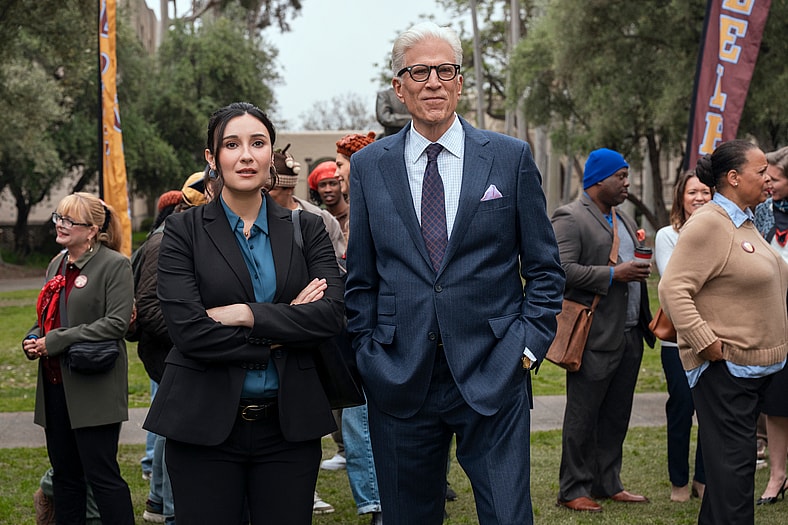
AMOTI_204_Unit_00706RC.jpg: A Man on the Inside. (L to R) Lilah Richcreek Estrada, who plays private investigator Julie Kovalenko, with Danson.